Warehouse Infrastructure Solutions: A 2026 Strategic Reference Guide
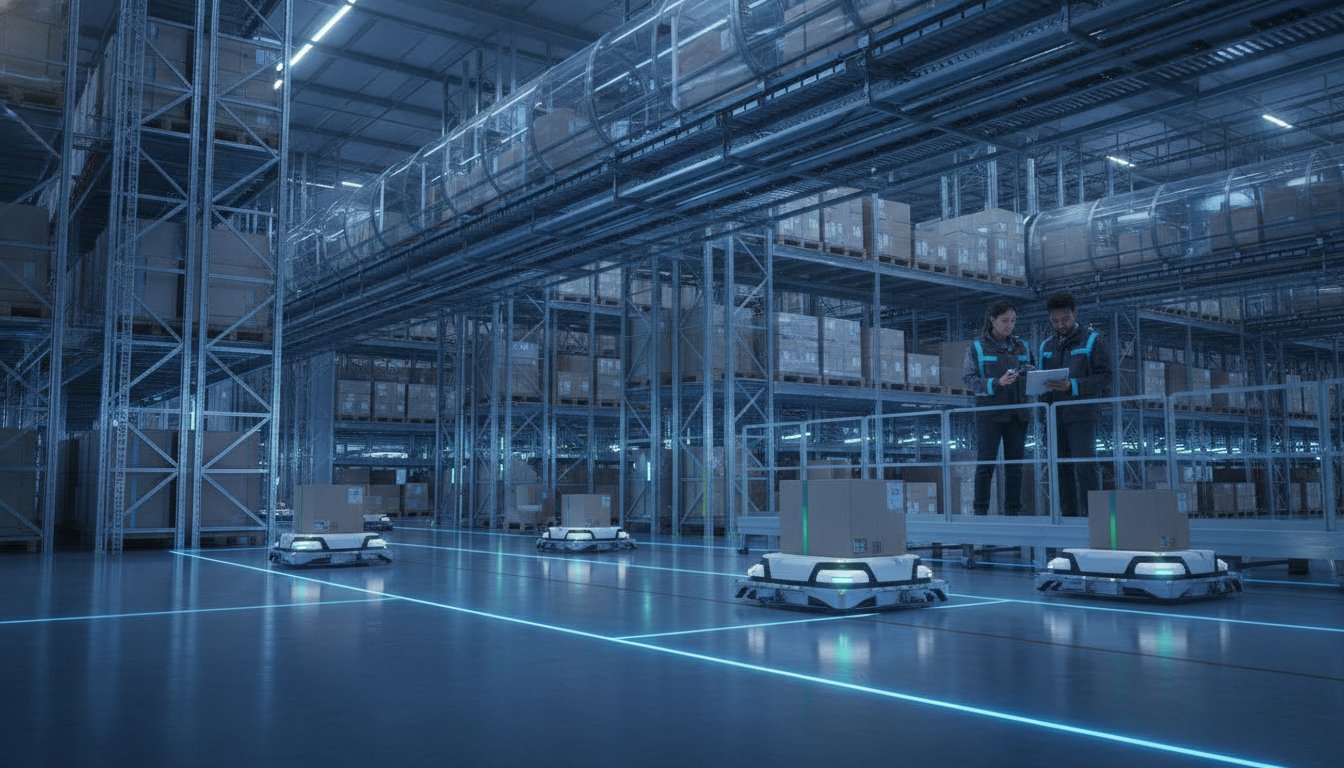
In 2026, your warehouse floor is no longer just a slab of concrete; it's the most critical component of your automation's central nervous system. Many facility managers are discovering that traditional storage methods are buckling under the weight of high-speed robotics and AI-driven throughput demands. It's a common frustration to realize that your existing racking doesn't align with new autonomous mobile robots or that your power grid lacks the capacity for a modern fleet. We understand that infrastructure should be an active engine for growth, not a passive container for inventory.
By mastering the right warehouse infrastructure solutions, you can transform these technical bottlenecks into long-term competitive advantages. This guide provides a strategic roadmap to help you build a scalable, automation-ready environment that maximizes every cubic inch of vertical space. We'll explore how to achieve seamless integration between storage systems and conveyor flow while ensuring your facility is fully prepared for the latest AI and robotics requirements. From meeting updated OSHA safety standards to optimizing floor space, you're about to learn how to future-proof your operations for the next decade of industrial excellence.
Key Takeaways
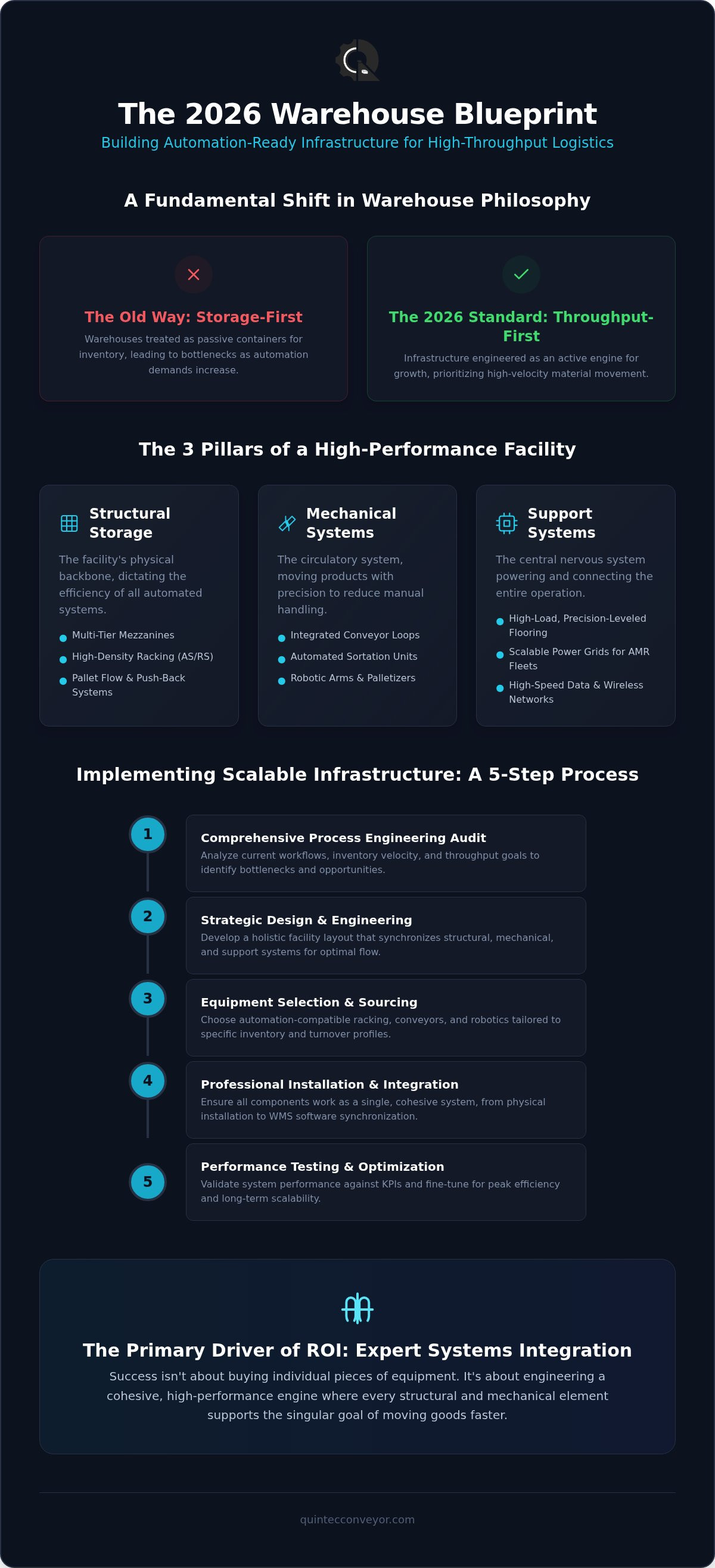
- Learn why 2026 logistics standards require a shift from "storage-first" to "throughput-first" design to support high-velocity material movement.
- Discover how to optimize your facility's vertical footprint using multi-tier mezzanines and racking systems tailored to specific inventory turnover rates.
- Understand the critical role of conveyors as the circulatory system of your operation and how to balance fixed and flexible mechanical frameworks.
- Master a strategic five-step implementation process for warehouse infrastructure solutions that begins with a comprehensive process engineering audit.
- Identify why expert systems integration is the primary driver of ROI, transforming individual equipment purchases into a cohesive, high-performance engine.
Defining Modern Warehouse Infrastructure Solutions
Modern warehouse infrastructure solutions are the integrated systems of structural, mechanical, and digital components that drive material movement. In 2026, the industry has transitioned from a "storage-first" mindset to a "throughput-first" architecture. This shift reflects a reality where speed is the primary currency of logistics. Infrastructure is the physical foundation of your ROI. If the racking is incompatible with the robotics, or the conveyor flow is poorly mapped, the entire operation stalls. Industrial infrastructure serves as the bedrock of warehouse profitability because it dictates the ceiling of your operational capacity. A well-engineered facility reduces labor costs per unit and minimizes product damage through better handling logic. When structural and mechanical systems work in harmony, you see shorter lead times and higher customer satisfaction.
The Evolution of Industrial Infrastructure
Logistics demands in 2026 differ sharply from traditional models. The rise of e-commerce and rapid fulfillment cycles requires high-density storage that doesn't compromise accessibility. It's no longer enough to have space; you must have accessible space. Modern warehouses aren't just buildings; they're sophisticated tools. High-density storage is essential for maximizing facility footprints in markets where real estate costs are climbing. However, these systems must be designed around professional warehouse design services to ensure operational flow. When engineering and design are decoupled, bottlenecks become inevitable. A throughput-focused approach uses every cubic inch of the facility footprint to support the constant motion of autonomous systems.
Key Components of a Modern Facility
A robust infrastructure strategy rests on several primary pillars that must be synchronized to achieve peak efficiency. Structural storage remains the physical backbone. This includes selective racking for high SKU counts, drive-in systems for bulk density, and multi-tier mezzanines that double or triple usable square footage without expanding the building's footprint. Mechanical systems act as the circulatory system of the facility. Integrated conveyor loops and automated sortation units move products with precision, reducing manual touches and transit times.
Support systems are often overlooked but remain critical for 2026 technology standards. These components include:
- High-load flooring: Precision-leveled concrete designed to withstand the weight of dense racking and the constant friction of high-speed robotics.
- Advanced power distribution: Scalable electrical grids capable of supporting massive fleets of autonomous mobile robots (AMRs) and their charging stations.
- Data cabling: High-speed fiber and wireless networks that ensure WMS platforms and AI controllers remain synchronized in real-time.
Success in modern logistics isn't about buying individual pieces of equipment. It's about engineering a cohesive environment where every structural and mechanical element supports a singular goal: moving goods faster.
Structural Storage and Racking: The Physical Framework
Structural storage serves as the skeleton of any facility, yet many organizations treat it as a secondary consideration. In reality, your racking configuration dictates the efficiency of every robotic arm and conveyor belt in the building. When selecting warehouse infrastructure solutions, you must align racking types with specific inventory velocity profiles. Fast-moving SKUs require pallet flow or push-back systems to maintain high-throughput rhythms, while slower-moving items are better suited for selective racking. For 2026 automation standards, load capacity isn't the only metric that matters; structural rigidity is equally vital. High-density automated storage and retrieval systems (AS/RS) demand exact tolerances to prevent mechanical jams. These systems often interface directly with industrial conveyor systems to create a seamless path from storage to shipping, eliminating the "dead time" typically found in manual picking environments.
High-Density Racking Solutions
Choosing between selective racking and pallet flow depends on your turnover goals. Selective racking offers 100% SKU accessibility, which is ideal for facilities with diverse, lower-volume inventory. However, high-throughput environments increasingly lean toward pallet flow or shuttle-based systems to maximize density. Precision is the hidden requirement here. As autonomous mobile robots (AMRs) become standard, racking must be installed with millimeter accuracy. If a rack upright is slightly out of plumb, a robotic picker may fail to register the bin location, leading to system timeouts. Under the OSHA National Emphasis Program effective July 31, 2026, structural integrity in high-load zones is under increased scrutiny. Ensuring your racking meets seismic and high-load engineering standards isn't just about performance; it's a mandatory safety compliance measure.
Mezzanines and Work Platforms
With 2026 warehouse lease rates averaging $9.00 per square foot nationally, and reaching up to $18 in coastal logistics corridors, expanding your footprint horizontally is often cost-prohibitive. Mezzanines and multi-tier work platforms allow you to double or triple your usable square footage within the same building shell. These structures aren't just extra floors; they're integrated components of the material handling logic. By using vertical conveyors to bridge mezzanine levels, you can create multi-level picking modules that keep labor on the platforms while automation handles the vertical transit. This approach requires rigorous structural engineering to account for the dynamic loads of moving machinery. If you're looking to optimize your vertical envelope, comprehensive infrastructure planning can help bridge the gap between simple storage and high-performance throughput.
Mechanical Infrastructure: Conveyors and Automation Integration
Mechanical infrastructure acts as the circulatory system of modern warehouse infrastructure solutions, pumping inventory through the facility with calculated precision. While the structural framework provides the skeleton, the mechanical layer determines the speed and consistency of your operations. In 2026, the debate between fixed and flexible infrastructure has shifted. High-throughput facilities still rely on fixed conveyor loops for core transport, but they're increasingly supplementing these with modular segments that can be reconfigured as product profiles change. This hybrid approach allows for high-speed stability while maintaining the agility needed for seasonal shifts or new SKU introductions.
Integrating these systems requires a deep understanding of spatial constraints. This is where low profile conveyors become invaluable. By minimizing the vertical footprint of the mechanical hardware, you can fit automation into existing structural frameworks without costly renovations. This compact design allows for more sophisticated sortation logic in tight picking modules or under mezzanine platforms. When sortation systems are integrated directly into the structural racking, the result is a high-density engine that moves products from storage to shipping with minimal human intervention.
Types of Conveyor Infrastructure
Selecting the right mechanical platform depends on the weight, shape, and velocity of your goods. Each system serves a specific role in the broader material handling logic:
- Belt conveyors: These remain the standard for general transport and incline applications where consistent product orientation is critical.
- Live roller and CDLR systems: Chain Driven Live Roller (CDLR) systems are engineered for heavy pallet movement, providing the torque necessary for high-load industrial environments.
- Modular systems: These offer the ultimate in facility adaptability. They allow managers to swap sections quickly, ensuring the infrastructure evolves alongside business growth.
Automation-Ready Mechanical Design
Preparing your facility for 2026 technology means designing for machine-to-machine interaction. Autonomous Mobile Robots (AMRs) are now common, but their efficiency depends on precise conveyor-to-robot handoff zones. If the mechanical interface isn't perfectly aligned, the robot's sensors will trigger a safety stop, creating an immediate bottleneck. Precision engineering at these junctions is non-negotiable for maintaining high-throughput rates.
Beyond physical alignment, your infrastructure must account for the auxiliary needs of automated systems. Pneumatic sortation and robotic arms require dedicated air lines and robust power distribution. In 2026, power capacity for AMRs is a critical factor; your mechanical design should include integrated charging stations and data drops to keep the fleet operational. By engineering these requirements into the initial layout, you avoid the high cost of retrofitting utilities later. This proactive approach ensures your mechanical framework supports the full potential of your automation investment.
Implementing Scalable Infrastructure: A 5-Step Strategic Process
Effective implementation of warehouse infrastructure solutions requires a methodical approach that bridges the gap between high-level design and physical reality. You can't simply install equipment and expect peak performance; you must engineer a system. This process ensures that every structural and mechanical component supports your specific operational logic. A successful deployment follows a structured five-step path:
- Step 1: Conduct a thorough facility and process engineering audit to identify current constraints and latent capacity.
- Step 2: Define throughput requirements and inventory velocity profiles based on actual data rather than broad projections.
- Step 3: Select integrated racking and conveyor systems that support both current needs and future technical compatibility.
- Step 4: Design for modularity to allow for rapid reconfiguration as your product mix or seasonal volumes evolve.
- Step 5: Establish a preventive maintenance schedule for all infrastructure components to ensure long-term reliability and stability.
Designing for Scalability and Modularity
Scalability isn't just about physical size; it's about the ability to pivot without massive capital reinvestment. In 2026, modular conveyor systems are essential for managing seasonal demand peaks. These systems allow you to add or remove segments quickly, ensuring your layout reflects your current order profile. Beyond the hardware, you must future-proof your power and data capacity. Next-gen AI systems and autonomous fleets require significantly more bandwidth and electrical load than traditional setups. Standardizing these infrastructure components across a national facility network ensures that your maintenance teams can support any site with a uniform set of procedures and spare parts.
Risk Mitigation in Infrastructure Projects
Large-scale projects carry inherent risks that can derail ROI if not managed proactively. Identifying bottlenecks before installation through digital simulation is now a standard requirement for complex builds. This allows you to test different material handling logics in a virtual environment before a single bolt is turned. You must also ensure strict compliance with national safety standards, including the revised OSHA National Emphasis Program for warehousing effective July 31, 2026. Working with a single-source integrator reduces project friction by eliminating the communication gaps that often occur between separate equipment vendors. This unified approach provides a clear path to execution and ensures that your structural and mechanical systems are perfectly synchronized. If you're ready to begin your next project, partner with a strategic engineering expert to ensure your facility is built for the demands of 2026.
Why Expert Integration is the Key to Infrastructure ROI
Buying industrial equipment is a transaction; engineering a solution is a partnership. In the high-stakes environment of 2026 logistics, the difference between these two approaches determines your facility's ultimate ceiling. Warehouse infrastructure solutions must be treated as a single, cohesive engine rather than a collection of independent assets. This is where professional process engineering becomes the primary driver of value. By optimizing material handling logic before the first piece of racking is installed, you eliminate the bottlenecks that plague poorly planned facilities. Quintec leverages over 100 years of collective experience to bridge the gap between abstract warehouse design and physical implementation. We don't just provide hardware; we deliver integrated throughput systems designed for long-term stability.
The Role of the System Integrator
A system integrator acts as the lead architect for your facility's internal ecosystem. Managing the complexity of multi-vendor projects is a significant challenge for modern operations. You need a partner who ensures seamless communication between structural storage and mechanical systems. If the racking isn't perfectly aligned with the conveyor handoff zones, your automation investment won't deliver the promised throughput. A national partner is critical for organizations managing a distributed network of facilities across the United States. It ensures consistent engineering standards and installation quality regardless of location. This unified approach reduces project friction and ensures that your infrastructure supports your broad business goals without regional variability.
Achieving Long-Term Operational Excellence
High-quality infrastructure is the most reliable predictor of labor efficiency. When your material handling logic is sound, your team spends less time navigating obstacles and more time fulfilling orders. Measuring the ROI of automated infrastructure investments requires looking past the initial price tag. You must account for reduced downtime, lower maintenance costs, and the ability to scale without major structural overhauls. Strategic maintenance and support services are essential for protecting these assets. By establishing a proactive care plan, you ensure your conveyors and robotics remain at peak performance.
Modernization isn't a one-time event. It's a continuous process of refinement. As you look toward the future, focus on creating an environment that adapts to the next generation of AI and robotics without requiring a total facility redesign. Professional integration ensures that your structural and mechanical layers remain flexible enough to handle whatever comes next in industrial technology. This commitment to engineering excellence is what transforms a standard warehouse into a high-performance fulfillment engine.
Engineering Your Competitive Edge for 2026 and Beyond
The logistics landscape of 2026 demands more than just a place to store goods. It requires a high-performance environment where structural frameworks and mechanical systems operate as a single, synchronized unit. By prioritizing throughput-first design and optimizing vertical footprints, you can overcome the rising costs of industrial real estate. We've explored how selecting the right warehouse infrastructure solutions transforms technical bottlenecks into scalable advantages, ensuring your facility remains ready for the next wave of automation.
Success in these complex builds depends on a partner who understands the intricate relationship between process engineering and physical installation. Quintec offers over 100 years of collective industry experience, providing national design, engineering, and installation services that bring precision to every project. Whether you're integrating complex conveyor networks or high-density racking systems, our team ensures your operations are built for long-term stability and excellence. It's time to build a facility that doesn't just house your inventory but actively accelerates your growth.
Partner with Quintec for Your National Infrastructure Integration and secure your operational future today.
Frequently Asked Questions
What are the main types of warehouse infrastructure solutions?
The primary types of warehouse infrastructure solutions include structural storage, mechanical transport systems, and digital support frameworks. Structural components consist of selective or high-density racking and multi-tier mezzanines that maximize vertical footprints. Mechanical systems involve integrated conveyors and automated sortation loops. Finally, support infrastructure encompasses the high-load flooring, advanced power grids, and data cabling necessary to sustain a modern, high-throughput industrial environment.
How does industrial infrastructure impact warehouse automation?
Infrastructure serves as the physical foundation upon which all automation relies. If your racking tolerances are off by even a few millimeters, robotic pickers may fail to identify bin locations. Similarly, autonomous mobile robots require precision-leveled flooring and high-bandwidth data networks to navigate safely. Without a robust and automation-ready infrastructure, even the most advanced robotics will suffer from frequent downtime and reduced operational efficiency.
What power requirements are typical for modern automated conveyors?
Power requirements vary based on the scale of the system, but modern automated conveyors often require 460V three-phase power for heavy-duty motors. Beyond the conveyors themselves, 2026 standards necessitate additional capacity for autonomous mobile robot (AMR) charging stations and pneumatic sortation systems. It's essential to audit your facility's electrical grid to ensure it can handle the concurrent loads of mechanical transport and digital control systems.
Can I upgrade my existing racking for robotic automation?
Upgrading existing racking is possible, but it requires a comprehensive process engineering audit to verify structural integrity and dimensional tolerances. Robotic systems demand higher precision than manual forklift operations. You may need to replace standard uprights with high-load components or install guidance rails for specific automated systems. It's often more cost-effective to integrate new high-density modules into your current layout rather than attempting to retrofit outdated racking.
Why is vertical space so important in warehouse infrastructure design?
Vertical space utilization is critical because national warehouse lease rates have climbed to an average of $9.00 per square foot in 2026. By utilizing multi-tier mezzanines and high-bay racking, you can double or triple your usable square footage without increasing your building's footprint. This approach allows you to maintain high inventory density while keeping operations in prime logistics corridors where horizontal expansion is either impossible or financially prohibitive.
What is the difference between a conveyor supplier and an infrastructure integrator?
A conveyor supplier typically focuses on the sale of individual mechanical components. In contrast, an infrastructure integrator like Quintec provides a holistic engineering approach. We synchronize structural racking, mechanical conveyors, and automation into a single, cohesive engine. Integrators manage the complexity of multi-vendor projects and ensure that every component, from the data cabling to the sortation logic, works in harmony to achieve your specific throughput goals.
How often should warehouse infrastructure undergo a maintenance audit?
We recommend a comprehensive infrastructure maintenance audit at least once every six months to ensure long-term reliability. These audits should check for structural rack damage, conveyor belt tension, and motor efficiency. Regular inspections are also necessary to remain compliant with the OSHA National Emphasis Program for warehousing, which took effect in July 2026. A proactive maintenance schedule prevents minor mechanical wear from escalating into catastrophic system failures.
What are the benefits of modular warehouse infrastructure in 2026?
Modular warehouse infrastructure solutions provide the agility needed to handle seasonal demand spikes and changing product profiles. These systems allow you to reconfigure conveyor segments or add storage modules quickly without a total facility redesign. This flexibility is essential for future-proofing your investment. As your business grows or your SKU mix evolves, modular components ensure your facility can adapt without the high costs associated with permanent, fixed-position installations.