The 2026 Checklist for Sourcing New Material Handling Equipment
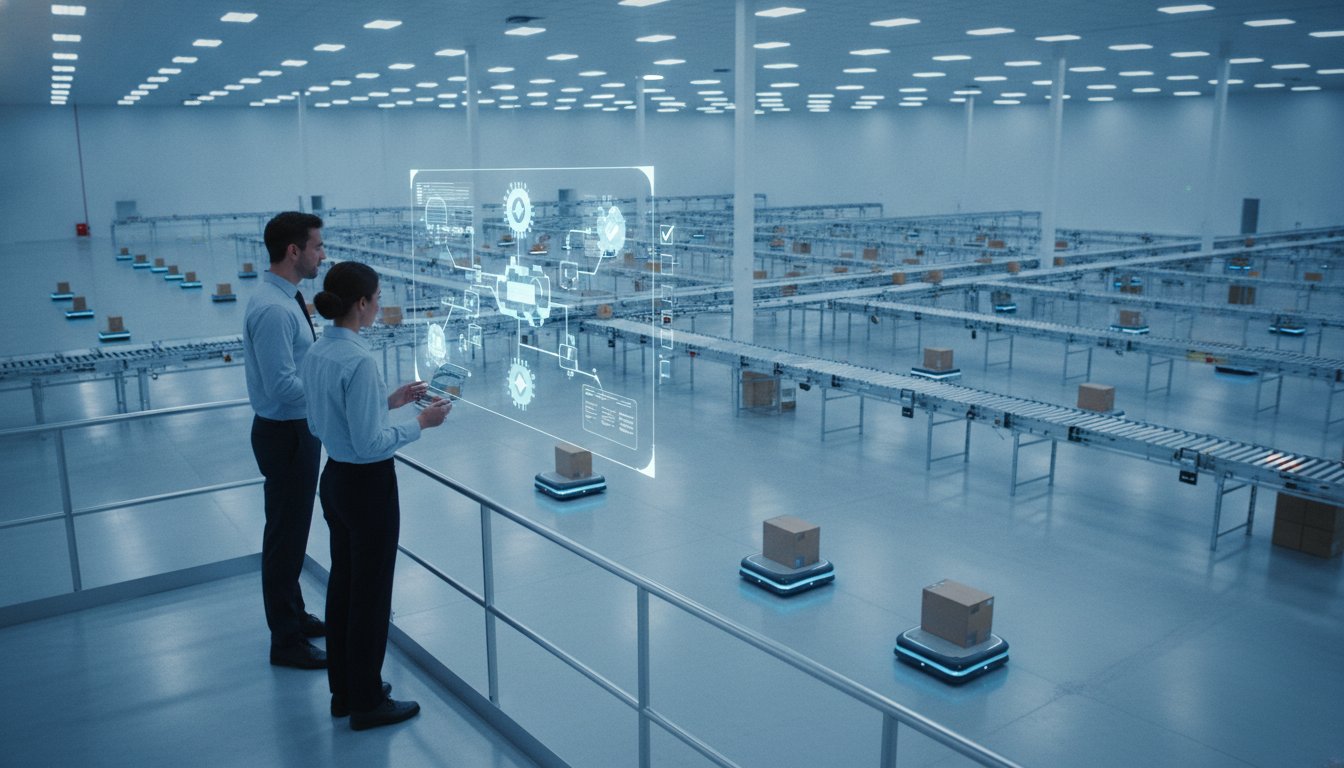
What if the most advanced piece of automation you purchase this year becomes the very thing that brings your entire operation to a standstill? It's a valid concern for any warehouse manager looking to upgrade. You understand that simply adding new material handling equipment isn't a guaranteed fix for rising labor costs or throughput demands. If your new robotics don't interface perfectly with your legacy conveyors, you've just traded a manual headache for a much more expensive technical bottleneck.
We recognize that the pressure to scale is immense, yet the risk of a fragmented system remains a constant threat to your operational flow. This guide provides a comprehensive 2026 checklist designed to help you evaluate, select, and integrate modern solutions with strategic precision. You'll learn how to prioritize modularity so your facility can grow without the need for constant, costly overhauls. We'll also examine the critical engineering and maintenance support needed to ensure your equipment operates at peak efficiency from the moment it's commissioned.
Key Takeaways
- Understand why sourcing new material handling equipment in 2026 requires viewing your facility as a unified ecosystem of hardware and software rather than a collection of isolated machines.
- Identify the essential mechanical and electrical compatibility checks needed to ensure that modern robotics and conveyors interface seamlessly with your legacy warehouse management systems.
- Learn how to prioritize modularity and scalability during the selection process to prevent stranded assets and ensure your infrastructure can adapt to future business growth.
- Discover the strategic advantage of partnering with a professional integrator to vet manufacturers and manage complex system installations for maximum operational throughput.
The 2026 Landscape: Why "New" Material Handling Equipment Requires a New Strategy
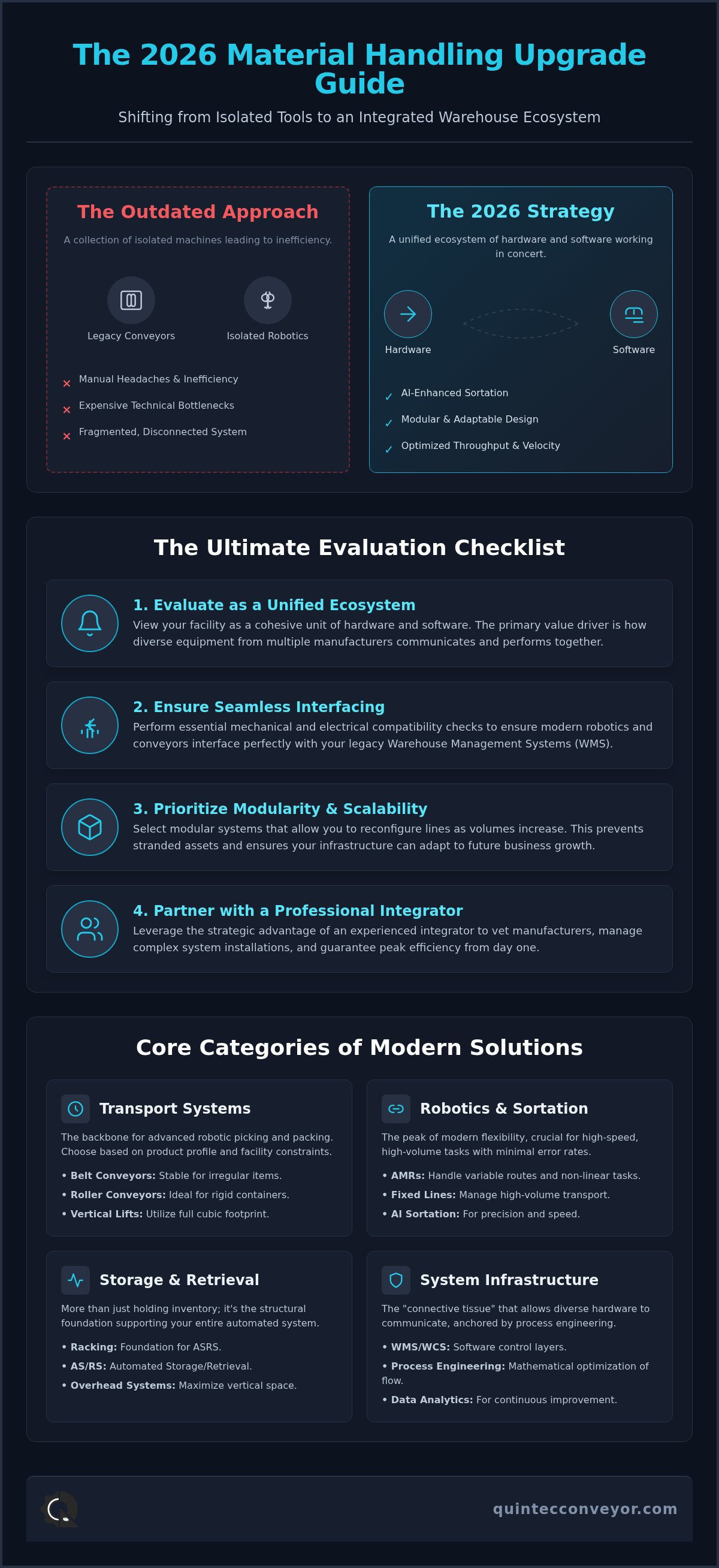
In 2026, the definition of new material handling equipment has evolved from a collection of mechanical assets to a unified ecosystem of hardware, software, and robotics. Modern facilities no longer view a conveyor or a robotic arm as a standalone purchase. Instead, these components must function as a single, cohesive unit. This shift is driven by the need for AI-enhanced sortation and modular facility designs that can adapt to rapid market changes without requiring a complete structural overhaul.
Transitioning from a reliance on manual labor to automated throughput excellence requires more than just capital investment. It demands a strategic approach rooted in engineering expertise. With over 100 years of collective industry experience, we've seen that the most successful projects prioritize how technology interfaces with existing infrastructure. Navigating these advancements is complex; a deep well of historical knowledge ensures that new innovations are grounded in proven mechanical reliability.
The Shift from Isolated Tools to Integrated Systems
Purchasing a standalone conveyor is no longer a viable strategy for high-volume logistics. Today's throughput demands require industrial conveyor systems that act as the backbone for advanced robotic picking and packing stations. System integration has become the primary value driver in modern warehousing. It's the connective tissue that allows diverse hardware from multiple manufacturers to communicate and perform at peak capacity. Without this integration, even the most expensive machinery remains an isolated tool that fails to deliver its full ROI.
Meeting 2026 Throughput Demands
Consumer expectations for lightning-fast delivery continue to rise. This pressure forces warehouses to implement high-speed sortation conveyors capable of handling thousands of units per hour with minimal error rates. As labor shortages persist, the adoption of automated material handling is no longer optional for those seeking to remain competitive. Efficiency is gained through the precise application of Process Engineering, which we define as the mathematical optimization of material flow to eliminate waste and maximize system velocity. By focusing on the total facility flow, you can ensure that your investment in new material handling equipment translates directly into measurable operational gains.
Core Categories of Modern Material Handling Solutions
Categorizing new material handling equipment requires a structured approach that views every asset as part of a larger mechanical hierarchy. The industry typically divides these solutions into four primary pillars: Transport, Storage, Robotics, and Infrastructure. While "Bulk" handling focuses on raw materials or loose items, industrial "Unit" handling deals with individual products, cases, or pallets. Success depends on how these categories overlap. For example, warehouse racking isn't just a storage solution; it's the structural foundation that supports your automated retrieval systems and overhead conveyors. Identifying the ideal category mix is a process best handled through custom material handling system design to ensure every asset serves a specific throughput goal.
Conveyor and Transport Systems
Choosing the right transport method depends entirely on your product profile. Belt conveyors provide stable movement for irregular items, while roller conveyors are ideal for rigid containers and accumulation. For facilities expecting rapid growth, modular conveyor systems offer the necessary flexibility to reconfigure lines as volumes increase. If horizontal space is limited, vertical conveyors allow you to utilize your facility's full cubic footprint, effectively doubling your usable area without expanding the building's walls. These systems ensure that your new material handling equipment integrates seamlessly with the physical constraints of your facility.
Robotics and Automated Sortation
The integration of Autonomous Mobile Robots (AMRs) with fixed conveyor lines represents the peak of modern flexibility. AMRs handle variable routes and non-linear tasks, while fixed lines manage high-speed, high-volume transport. High-speed sortation systems are essential for reducing order cycle times, ensuring packages move from picking to shipping in minutes rather than hours. At the end of the line, robotic picking arms provide consistent palletizing, reducing the physical strain on your workforce and ensuring pallets are built for stability. If you're unsure which automation tier fits your current volume, speaking with an expert at Quintec Conveyors can help clarify your requirements based on your specific operational data.
The Ultimate Checklist for Evaluating New Equipment
Sourcing new material handling equipment in 2026 requires a shift from isolated procurement to a rigorous engineering evaluation. Precision is non-negotiable. Before finalizing any purchase, you must verify that the new hardware interfaces physically with your existing lines. This mechanical compatibility extends beyond simple dimensions; it includes speed synchronization and weight capacity alignment across the entire system. Equally critical is the electrical and control logic. Your current Warehouse Management System (WMS) must be able to communicate with the new hardware without latency or data silos. If the equipment can't talk to your software, it's a liability, not an asset.
Throughput requirements should always be measured against peak-hour demand rather than daily averages. Equipment that handles your average flow might fail during seasonal spikes, creating backlogs that ripple through the facility. Additionally, safety and ergonomics must meet the latest 2026 OSHA standards, particularly regarding human-robot collaboration. Ensuring that automated systems have the necessary sensors and light curtains to protect your workforce is a fundamental requirement of modern facility management.
Operational and Integration Readiness
Success in integration depends on a detailed assessment of your facility's existing capabilities. Use the following checklist items to gauge readiness:
- Electrical Load Verification: Confirm that your current facility infrastructure can support the power requirements of high-performance robotics and conveyors without upgrades.
- Footprint-to-Flow Ratio: Assess whether the physical space occupied by the equipment allows for optimal traffic flow or if it creates new physical bottlenecks.
Managing these technical checks is a complex task that often requires the expertise of a professional conveyor system integrator. An integrator ensures that every mechanical and digital interface is vetted before installation begins, reducing the risk of costly post-purchase modifications.
Maintenance and Longevity Factors
The true value of new material handling equipment is revealed over years of operation, not just the first month. Evaluating the Total Cost of Ownership (TCO) is essential. This includes the initial purchase price, energy consumption, and the long-term cost of upkeep. Confirm the availability of spare parts and ensure you have access to national maintenance support to minimize downtime. Accessible design is another priority; your team must be able to perform routine inspections and minor repairs without a total system shutdown. If maintenance access is restricted, your operational reliability will eventually suffer.
Strategic ROI: Scalability and Future-Proofing
ROI isn't just a calculation of initial capital against immediate output. When you invest in new material handling equipment, the true return is found in the system's ability to evolve alongside your business. Modularity is the primary defense against "stranded assets", which are expensive pieces of machinery that become obsolete the moment your SKU mix or order volume changes. By utilizing professional warehouse design services, you can map out 5-year and 10-year growth cycles. This proactive engineering ensures that the infrastructure you install today doesn't become a physical barrier to the automation you'll need tomorrow.
Calculating a realistic ROI requires you to look beyond simple labor replacement. You must factor in the precision of automated sortation, which drastically reduces expensive shipping errors and returns. High-performance systems also increase facility uptime by operating with higher mechanical reliability. Opting for "cheap" equipment often creates a false economy. Lower upfront costs are frequently erased by high maintenance requirements and frequent downtime. In a high-velocity environment, a single hour of system failure can cost more than the price difference between a budget component and an industrial-grade solution.
Designing for Scalability
Modern facilities require a "plug-and-play" approach to expansion. This is where modular conveyor systems provide a distinct advantage. They allow for rapid reconfiguration as your business needs shift, particularly in fast-paced e-commerce sectors where volume spikes are unpredictable. Beyond physical hardware, software-first engineering is essential. You need systems that can receive AI updates and logic improvements without requiring mechanical overhauls. This digital scalability ensures your new material handling equipment stays at the cutting edge for its entire operational lifecycle.
The Hidden Costs of Poor Integration
Integration Friction occurs when new hardware fails to align with legacy systems, leading to manual workarounds that drain efficiency and increase labor costs. Process engineering prevents these expensive post-installation reworks by mathematically optimizing the flow before a single bolt is tightened. Working with a national partner ensures consistent equipment standards across all your locations, which simplifies training and spare parts management. If you're ready to secure your facility's future, contact Quintec Conveyors to discuss a scalable equipment strategy.
Partnering for Success: How an Integrator Simplifies Sourcing
Selecting new material handling equipment is only one part of a larger operational puzzle. While an equipment vendor focuses on the specifications of a single machine, a conveyor system integrator focuses on how that machine enhances your entire facility flow. Quintec Conveyors utilizes over 100 years of collective industry experience to vet manufacturers, ensuring you receive hardware that meets our rigorous standards for durability and integration. This strategic partnership moves you beyond simple procurement and into the territory of custom-engineered solutions that are built to last.
The lifecycle of a successful integration project follows a methodical progression. It begins with a deep dive into your current processes and ends with a professional installation that minimizes operational disruption. Successful material handling isn't just about the machines; it's about the "flow," which is the seamless movement of goods from receiving to shipping with zero wasted motion. By sourcing through an integrator, you ensure that every piece of new material handling equipment contributes to a unified, high-throughput system.
Comprehensive Engineering and Maintenance
Protecting your investment requires more than a successful launch. Leveraging professional maintenance services ensures your systems continue to operate at peak efficiency long after the initial installation. Our process engineering team specializes in identifying subtle bottlenecks that could impact your ROI if left unaddressed. With a national reach, we provide consistent engineering standards across the United States. This consistency allows multi-location enterprises to maintain uniform performance and safety protocols, regardless of where their facilities are located. Reliability is built into our engineering from day one, ensuring your mechanical assets remain productive for their entire service life.
Your Next Steps in Facility Modernization
Modernizing a facility in 2026 requires a data-driven starting point. A custom design consultation allows us to align your equipment needs with your specific growth targets. Before selecting any hardware, a thorough site audit is essential to understand the physical and digital constraints of your current environment. This prevents the common mistake of purchasing equipment that doesn't fit the reality of your floor space or software architecture. If you're ready to optimize your operation, Contact Quintec Conveyors for a comprehensive material handling audit. We provide the steady hand and strategic guidance needed to navigate complex large-scale projects with confidence.
Engineering Your Facility for the Future of Logistics
Success in 2026 requires moving beyond the purchase of individual machines to the creation of a unified, modular ecosystem. As we've explored, the right new material handling equipment must integrate seamlessly with your existing software and mechanical infrastructure to eliminate bottlenecks. Prioritizing modularity and process engineering today ensures your facility remains scalable and protected against the high costs of stranded assets in the future.
Navigating these complex technological shifts is simpler with an experienced partner at your side. Quintec Conveyors brings over 100 years of collective industry experience to every project, offering full-scale design, engineering, and installation services. Our national maintenance and support network provides the long-term stability your operation demands. We're ready to help you transform your warehouse into a high-throughput leader. Optimize your facility with Quintec Conveyors’ custom material handling solutions. Your facility's peak efficiency is within reach.
Frequently Asked Questions
What is considered new material handling equipment in 2026?
In 2026, new material handling equipment refers to a unified ecosystem of hardware, software, and robotics rather than isolated tools. This includes AI-enhanced sortation systems, autonomous mobile robots (AMRs), and modular conveyors designed for rapid reconfiguration. These solutions prioritize data connectivity and mechanical flexibility. By viewing equipment as an integrated system, facilities can achieve higher throughput while maintaining the ability to adapt to changing market demands without a complete rebuild.
How do I know if my warehouse is ready for automated sortation?
Your warehouse is ready for automated sortation when manual processes can't meet peak throughput demands or when labor costs begin to erode your margins. A professional site audit is the best way to confirm readiness. We evaluate your current footprint-to-flow ratio and SKU profiles to determine if automation will provide a positive return. If your facility experiences frequent bottlenecks during high-volume periods, it's a clear indicator that modernization is necessary.
Can new automated equipment be integrated with my existing conveyors?
Yes, new material handling equipment can be integrated with legacy conveyors through precise mechanical and electrical synchronization. Success depends on verifying that the control logic of the new hardware can communicate with your existing Warehouse Management System (WMS). We specialize in bridging the gap between old and new systems. This ensures that your facility maintains a continuous flow without the need to replace your entire infrastructure at once.
What is the difference between a material handling vendor and an integrator?
An equipment vendor typically sells standalone products, while an integrator designs and implements a complete operational flow. Quintec Conveyors acts as an integrator, utilizing over 100 years of collective experience to vet multiple manufacturers and ensure all components work as a single unit. We handle the design, engineering, and installation. This approach focuses on the final throughput result rather than just the delivery of individual mechanical assets.
How much does it cost to install a new integrated conveyor system?
The cost of an integrated system depends on several variables, including your required throughput velocity, the complexity of the control logic, and the scale of the physical footprint. While initial capital requirements vary, it's essential to evaluate the total cost of ownership over the equipment's lifecycle. Factors such as energy efficiency, modular expansion capabilities, and maintenance requirements play a significant role in determining the long-term financial impact of the investment.
What are the safety requirements for industrial robotics in 2026?
Safety requirements for 2026 center on advanced human-robot collaboration as defined by current OSHA standards. Modern equipment must include integrated sensors, light curtains, and emergency stop systems that allow humans to work safely alongside automated machinery. These safety protocols are built into the system's logic to prevent accidents during high-speed operations. Ensuring your hardware meets these rigorous safety benchmarks is a fundamental part of our engineering process.
How often does new material handling equipment require maintenance?
Maintenance frequency is typically determined by operational volume and the specific environment of your facility. Modern systems often utilize predictive maintenance sensors that alert your team to potential issues before they cause a failure. Regular professional inspections and a consistent maintenance schedule are critical for protecting your investment. We provide national maintenance support to ensure your conveyors and robotics continue to operate at peak efficiency with minimal unplanned downtime.
What is the expected ROI for warehouse automation upgrades?
The expected ROI for automation upgrades is realized through a combination of increased facility uptime, reduced order cycle times, and lower labor dependency. While every facility's results differ, the primary drivers of return are the elimination of manual errors and the ability to handle higher volumes during peak seasons. Strategic investments in modular equipment also provide ROI by reducing the risk of stranded assets, allowing your infrastructure to grow alongside your business.