The Strategic Benefits of Low Profile Conveyors in Modern Facility Design
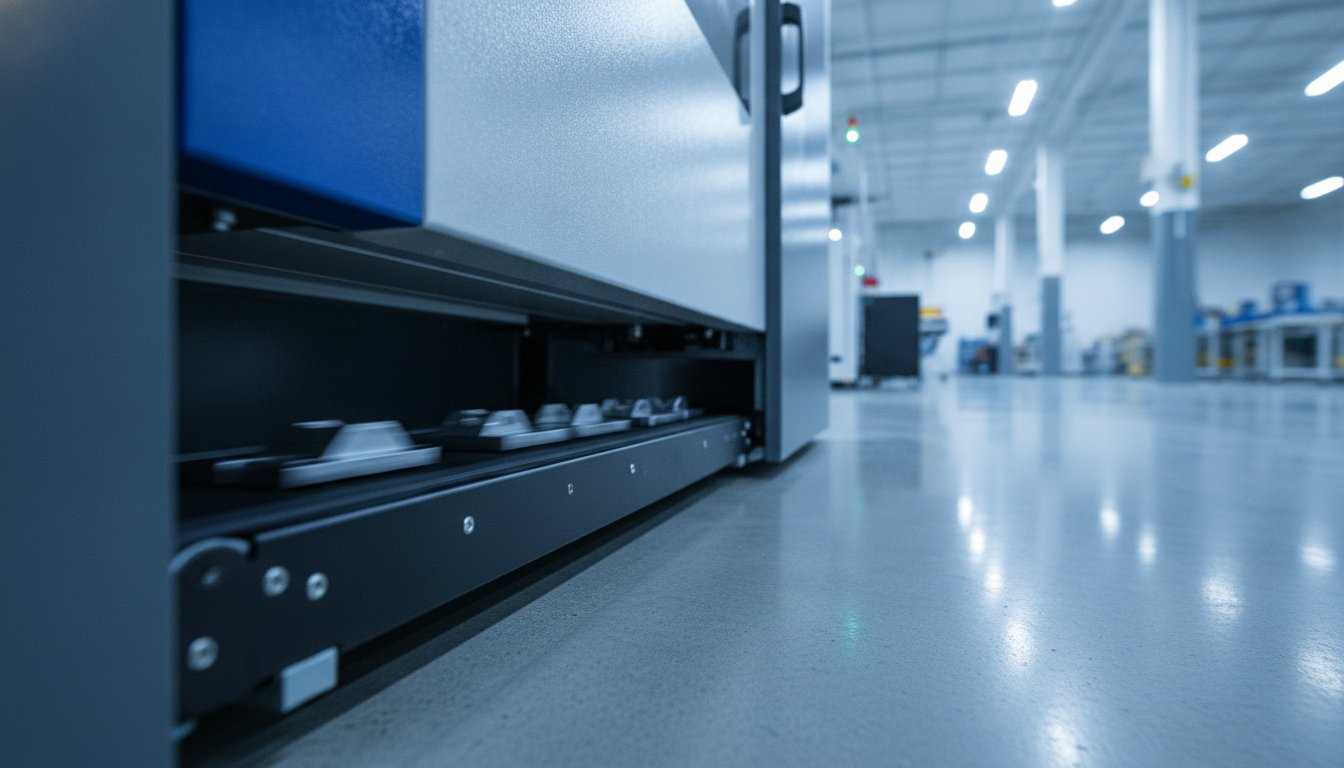
The most significant hurdle to warehouse automation often isn't the sophisticated software; it's the rigid physical footprint of the hardware itself. You've likely faced the frustration of trying to wedge a standard conveyor frame into a facility that has already reached its capacity. When floor space is at a premium and existing OEM machinery leaves no room for error, a low profile conveyor becomes more than just a piece of equipment; it's a strategic architectural tool. These compact systems are designed specifically for the tightest industrial environments, allowing you to reclaim valuable square footage without sacrificing the high-speed throughput your operations demand.
We recognize that integrating new technology into a legacy layout is a complex logistical puzzle. It's difficult to maintain access for repairs when equipment is crammed together, and manual handling often persists simply because traditional belts won't fit. This article will show you how to solve those critical space constraints while driving automation efficiency. We'll explore the seamless integration of low profile units with modern robotics, the benefits of custom-engineered compact frames, and how these systems reduce manual touches in small-parts processing. By the end, you'll see how to maximize your facility's footprint through smarter, more agile hardware choices.
Key Takeaways
- Learn why the shift to industrial-grade systems with frame heights under two inches is essential for modern high-throughput environments.
- Understand the engineering requirements for precision belt tracking to ensure the reliable handling of delicate or small components.
- Explore how a low profile conveyor can be strategically integrated into modular layouts to optimize under-machine part removal and scrap management.
- Evaluate selection criteria based on operational bottlenecks and Total Cost of Ownership rather than just initial hardware expenditure.
- Discover how to future-proof your 2026 facility plan by using reconfigurable sections that maintain a seamless material flow.
Defining the Low Profile Conveyor: Beyond Compact Dimensions
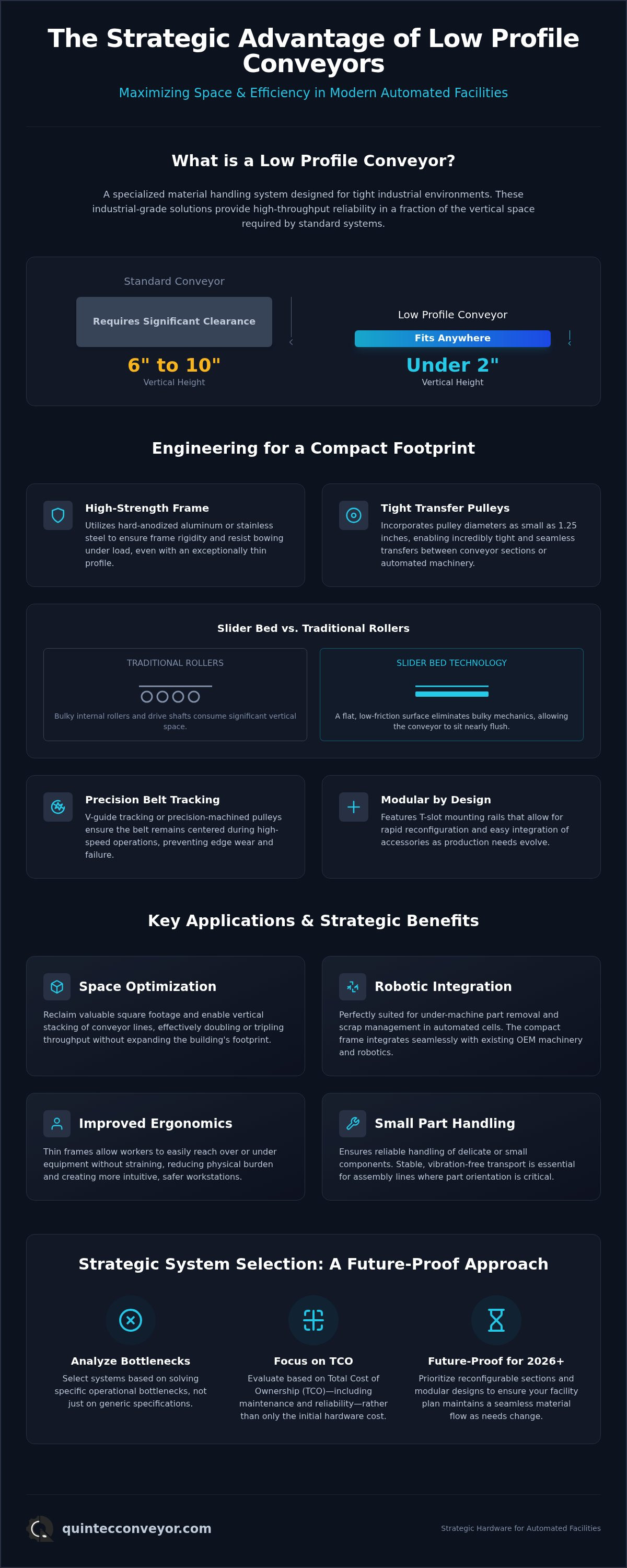
A low profile conveyor is a specialized material handling system characterized by a frame height that is typically under 2 inches. While these units were once relegated to miniature applications or light laboratory environments, they've matured into rugged, industrial-grade solutions. Unlike a standard deep-bed conveyor that might require six to ten inches of vertical clearance, the low profile design provides high-throughput reliability in a fraction of the space. This evolution is essential for modern industrial conveyor systems, where every millimeter of floor and shelf space must be justified by operational efficiency. These systems act as the connective tissue in complex layouts, fitting into gaps where traditional equipment simply won't function.
The Anatomy of a Low Profile System
Engineers achieve these slim dimensions by utilizing high-strength materials like hard-anodized aluminum or stainless steel. These materials ensure the frame remains rigid and resists bowing under load, even when the profile is exceptionally thin. Precision is key in these designs. Most systems incorporate pulley diameters as small as 1.25 inches, which facilitates incredibly tight transfers between conveyor sections or into automated machinery. To maintain this slim stature, manufacturers replace traditional rollers with slider bed technology. While a traditional Lineshaft roller conveyor relies on a series of rollers and internal drive shafts that consume significant vertical space, the slider bed uses a flat, low-friction surface. This design choice eliminates the bulk of mechanical power-transmission apparatus beneath the belt, allowing the conveyor to sit nearly flush against machine beds or worktables.
Why Vertical Space is the New Industrial Frontier
As we move through 2026, the trend toward high-density warehouse layouts has transformed how facility managers view vertical space. It's no longer just about the height of the racking; it's about the density of the processing lines themselves. Low profile frames enable stacking, where multiple conveyor lines operate vertically within the same footprint. This approach effectively doubles or triples throughput without expanding the building's physical walls. Beyond sheer capacity, these designs offer significant ergonomic advantages. Because the frames are so thin, workers can easily reach over or under the equipment without straining. This reduces the physical burden on employees and allows for more intuitive workstation setups. In a landscape where labor shortages drive a need for better working conditions, the low profile conveyor serves as both a space-saver and a tool for employee retention.
Engineering Advantages of Low Profile Designs
Engineering a high-performance low profile conveyor requires a level of precision that standard, bulkier systems often overlook. When dealing with narrow frames and slim profiles, belt tracking becomes a critical factor. A minor misalignment that might be negligible on a wide, heavy-duty belt can cause immediate edge wear or failure in a compact system. Most high-quality units utilize V-guide tracking or precision-machined pulleys to ensure the belt remains centered, even during high-speed operations. This stability is essential when the goal is to move small parts for assembly, as even the slightest vibration or shift can disrupt part orientation. These systems are also inherently modular, often featuring T-slot mounting rails that allow for rapid reconfiguration as your production needs evolve. To maintain reliability in such a small footprint, engineers utilize high-performance bearings housed in compact, sealed units. Since these small housings have less mass to dissipate heat, the quality of the lubrication and the precision of the bearing fit are non-negotiable for long-term stability.
Drive and Motor Configurations for Tight Spaces
Drive placement is frequently the most difficult bottleneck in modern facility design. Choosing between an end-drive and a center-drive configuration depends entirely on your specific transfer requirements. Center-drives are often preferred because they leave both ends of the conveyor open, facilitating tight transfers between machines. If vertical clearance is your primary constraint, side-mount motor packages or internal drum motors can eliminate the need for under-slung components. Integrating these units with Variable Frequency Drives (VFDs) allows for precise speed control, ensuring the conveyor remains perfectly synchronized with robotics or other automated equipment. If you're struggling to determine which configuration suits your existing machinery, consulting with experts in process engineering can help identify the most efficient integration path.
Belt Technology for Small Pulley Diameters
The small pulley diameters found in low-profile systems, often as small as 1.25 inches, place significant stress on the belt material. Standard belts frequently fail in these environments due to flex fatigue, which leads to premature cracking and delamination. To solve this, specialized materials like high-flex urethane or silicone are employed to ensure the belt can withstand millions of cycles around tight radii. For applications involving elevation changes, cleated belt options are available even within these slim frames. These cleats provide the necessary grip for inclines or declines without adding significant height to the overall system profile, maintaining the compact integrity of the low profile conveyor design.
Key Applications: Where Low Profile Conveyors Excel
Low profile conveyors aren't just niche accessories; they're the architectural backbone for facilities that have outgrown their physical footprint. Their slim design creates a natural synergy with modular conveyor systems, allowing engineers to snap compact sections into larger, scalable layouts. This modularity is particularly useful in "under-machine" applications. In metal stamping or plastic injection molding, the clearance beneath the press is often measured in inches. A low profile conveyor fits into these tight voids, continuously removing scrap or finished parts to prevent production halts without requiring a massive equipment overhaul.
Precision is another area where these systems dominate. In high-speed labeling and marking stations, the flat, stable surface of a low-profile unit ensures that high-speed thermal printers or laser markers apply codes with micron-level accuracy. For medical and pharmaceutical manufacturing, stainless steel variants meet strict clean-room standards. These units provide a contamination-free path for delicate vials and syringes, where bulky drive motors would otherwise trap dust and interfere with laminar airflow.
Robotics and Automation Workcells
The rise of the "lights-out" factory has placed the low profile conveyor at the center of the robotics revolution. These units often act as the precise "hand-off" point for 6-axis robotic arms, where height consistency is paramount for successful part picking. Current research into integrating compact conveyor belts with robotics highlights how these systems use advanced sensors for precise part positioning. This ensures that the robot doesn't just pick a part, but picks it at the exact coordinate required for the next assembly step. Furthermore, these conveyors are becoming standard features on AGV and AMR (Autonomous Mobile Robot) loading docks. Their low height allows the mobile robot to slide underneath the conveyor for a seamless, automated transfer of goods across the warehouse floor.
Packaging and E-commerce Sortation
In the high-velocity world of e-commerce, vertical density is the primary goal. Low profile units are essential for multi-tier sortation systems where multiple levels of conveyors are stacked to maximize throughput in a single aisle. These systems integrate perfectly with on-demand packaging solutions, such as those provided by Packsize, by feeding custom-sized boxes directly into the shipping loop. Because the frames are so thin, they can be tucked into the small gaps between larger sortation loops, acting as the critical "last-inch" connection that keeps the flow moving without creating a physical bottleneck for floor staff.
Strategic Selection: How to Choose the Right Low Profile System
Selecting a low profile conveyor requires looking beyond the immediate physical dimensions of the unit. You must first identify the primary bottleneck within your workflow. Is the goal to eliminate manual handling in a confined space, or are you trying to achieve higher precision for a labeling station? Once the objective is clear, evaluate the Total Cost of Ownership (TCO) rather than focusing solely on the initial hardware price. Compact systems often require more frequent belt inspections or specialized bearings due to high-speed operation in tight spaces; choosing a high-quality unit early prevents costly downtime later.
Environmental factors are equally critical. If your facility processes food or pharmaceuticals, a stainless steel washdown frame is mandatory. For electronics assembly, static-safe belts protect sensitive components from ESD damage. In machining environments, oil-resistant materials prevent the belt from swelling or slipping when exposed to cutting fluids. To navigate these variables, it's best to consult with an experienced conveyor system integrator who can ensure the unit is compatible with your broader automation strategy.
Calculating Load and Speed Requirements
Load capacity calculations change significantly when moving from rollers to low profile slider beds. Because the belt slides directly over a metal plate, friction is much higher. This friction requires higher motor torque, especially during startup when the belt is fully loaded. To determine your specific targets, you should use a checklist that covers the total weight of parts on the belt at peak load, the desired parts per minute (PPM) for downstream equipment, and the coefficient of friction between the belt material and the slider bed. Precise indexing also requires an analysis of acceleration and deceleration requirements to prevent part slippage.
In-House vs. Integrated Installation
Many facilities attempt to save costs with "bolt-on" low profile units purchased as standalone hardware. The risk here is a lack of synchronization with the main production line, which often leads to jams or sensor lag. Professional conveyor installation ensures that the electrical integration and controls programming are seamless. A properly integrated unit communicates with the rest of the facility; this allows for automated start-stop cycles that save energy and reduce mechanical wear. If you are looking to maximize your facility's efficiency, our experts can help you design and implement a fully integrated conveyor system tailored to your space constraints.
Integrating Low Profile Conveyors into Your 2026 Facility Plan
Building a resilient 2026 facility plan requires a shift from buying hardware to architecting flow. When you leverage professional warehouse design services, the integration of a low profile conveyor isn't an afterthought. It's a foundational element of high-density logistics. These units provide the necessary flexibility to future-proof your operations. Because they're modular and reconfigurable, you can pivot your layout as SKUs change or automation needs increase. Quintec focuses on this system-wide visibility. We ensure every compact section contributes to a holistic material handling strategy rather than existing as an isolated, underperforming island of automation. Taking a holistic view prevents the fragmented workflows that often result from piecemeal equipment purchases.
The Role of Process Engineering
Process engineering is the discipline that turns a collection of belts and motors into a high-performance system. It optimizes the logic behind every movement, ensuring that your low profile conveyor sections aren't just moving parts, but are perfectly timed with downstream sortation or assembly. We utilize advanced simulation software to test these integrations in a virtual environment before a single bolt is tightened on your floor. This allows us to identify potential bottlenecks and refine the transition from manual handling to automated, low-profile loops. It's about ensuring the digital plan and the physical reality are perfectly aligned for modern industrial standards.
Maintenance and Reliability in Tight Spaces
A common concern among facility managers is that compact systems are difficult to service due to their size and placement. We address this head-on with designs that prioritize accessibility. Many modern low-profile units feature quick-change belt mechanisms and tool-less maintenance options that allow for rapid repairs even in confined areas. Reliability is built into the engineering; we focus on high-performance components that support a goal of 99.9% uptime. By implementing a structured preventative maintenance program, you protect your investment and ensure your specialized compact equipment remains a reliable asset for years to come. Our deep industry experience allows us to provide the steady guidance needed to manage these complex logistical challenges with confidence.
Optimizing Your Facility for the Next Generation of Automation
Implementing a low profile conveyor is a decisive step toward maximizing the potential of your existing facility footprint. These systems provide the necessary clearance for advanced robotics and under-machine part removal; they bridge the gap between stagnant layouts and high-density automation. By prioritizing precision-engineered components and strategic process integration, you can eliminate manual bottlenecks and ensure your 2026 facility plan is ready for the demands of high-throughput logistics. Choosing the right hardware is only the beginning; the real value lies in how these units are integrated into your wider material handling ecosystem.
Successful automation requires a partner that understands the nuances of industrial planning. Quintec brings over 100 years of collective engineering experience to every project, offering specialized expertise in warehouse automation and robotics. We provide full-scale national installation and maintenance support to ensure your infrastructure remains a stable asset. Contact Quintec Conveyors for a Custom Integration Consultation to begin designing a solution tailored to your specific operational challenges. We're ready to help you build a more efficient and resilient future.
Frequently Asked Questions
What is the standard height of a low profile conveyor?
The standard frame height of a low profile conveyor is typically under 2 inches, with some ultra-thin models reaching as low as 1.5 inches. This compact vertical dimension allows the equipment to fit into spaces where traditional conveyors cannot. Engineers specifically design these units for under-machine scrap removal and tight transfers between automated workcells. This slim stature is achieved by replacing rollers with slider bed technology and utilizing precision-machined pulleys.
Can low profile conveyors handle heavy industrial loads?
These systems are capable of handling significant industrial loads when engineered with high-strength materials like hard-anodized aluminum or stainless steel. While they're often associated with small parts, their rigid frame designs prevent bowing or misalignment under weight. The primary limitation is the increased friction of the slider bed surface compared to rollers. Using high-torque motors and precision bearings ensures these compact units maintain high-throughput reliability even when transporting dense components.
Are low profile conveyors suitable for washdown environments?
Many low profile conveyor systems are specifically designed for washdown environments in medical, pharmaceutical, and food processing facilities. These models typically feature 304 or 316 stainless steel frames and specialized sanitary belts that resist bacterial growth. The compact design minimizes areas where debris can collect, facilitating easier cleaning protocols. For high-hygiene applications, it's essential to select a unit with a washdown-rated motor and bearings to ensure long-term mechanical integrity under harsh cleaning cycles.
How do low profile conveyors integrate with existing automation machinery?
Integration with existing automation machinery is achieved through the use of advanced sensors, Variable Frequency Drives (VFDs), and standardized mounting rails. These conveyors often act as the precise hand-off point for 6-axis robotic arms or feed into larger sortation loops. By programming the conveyor's control logic to sync with the broader system, you ensure seamless part positioning and automated start-stop cycles. This connectivity is essential for maintaining the high-speed efficiency required in modern, high-density industrial environments.
What types of belts are best for small pulley diameters?
High-flex materials like urethane or silicone are best for small pulley diameters because they resist the flex fatigue that causes standard belts to crack. Because low profile pulleys can be as small as 1.25 inches, the belt must be thin enough to wrap around the radius millions of times without delamination. We often recommend belts with integrated V-guides or precision-machined pulley interfaces to ensure perfect tracking, even when handling delicate or orientation-sensitive assembly parts.
Do low profile conveyors require specialized maintenance?
While low profile units don't necessarily require more complex maintenance, they do benefit from a structured preventative approach. Their compact housings mean bearings and belts are under higher stress, making regular inspections for wear and tension essential. Many modern designs include quick-change belt features and tool-less adjustment options to simplify repairs in confined areas. Maintaining 99.9% uptime depends on proactive lubrication and monitoring, ensuring that the specialized components within the slim frame continue to perform reliably.
How does motor placement affect the profile of the conveyor?
Motor placement significantly impacts the overall profile and integration flexibility of the equipment. An end-drive configuration is standard but adds length to the frame, while a center-drive keeps both ends open for tight transfers. Side-mount motor packages or internal drum motors are often used to keep the vertical clearance clear, allowing the conveyor to sit flush against machine beds. Choosing the correct drive location is a critical step in process engineering to avoid physical interference with existing machinery.
Can low profile conveyors be used for incline or decline applications?
Low profile systems are highly effective for incline or decline applications when equipped with cleated belts. These cleats provide the necessary grip to move parts vertically between levels without significantly increasing the frame's profile. This capability is particularly useful in multi-tier sortation or when feeding parts from a low-clearance machine into a higher collection bin. The modular nature of these conveyors allows for precise angle adjustments, ensuring a smooth and consistent material flow throughout the facility.