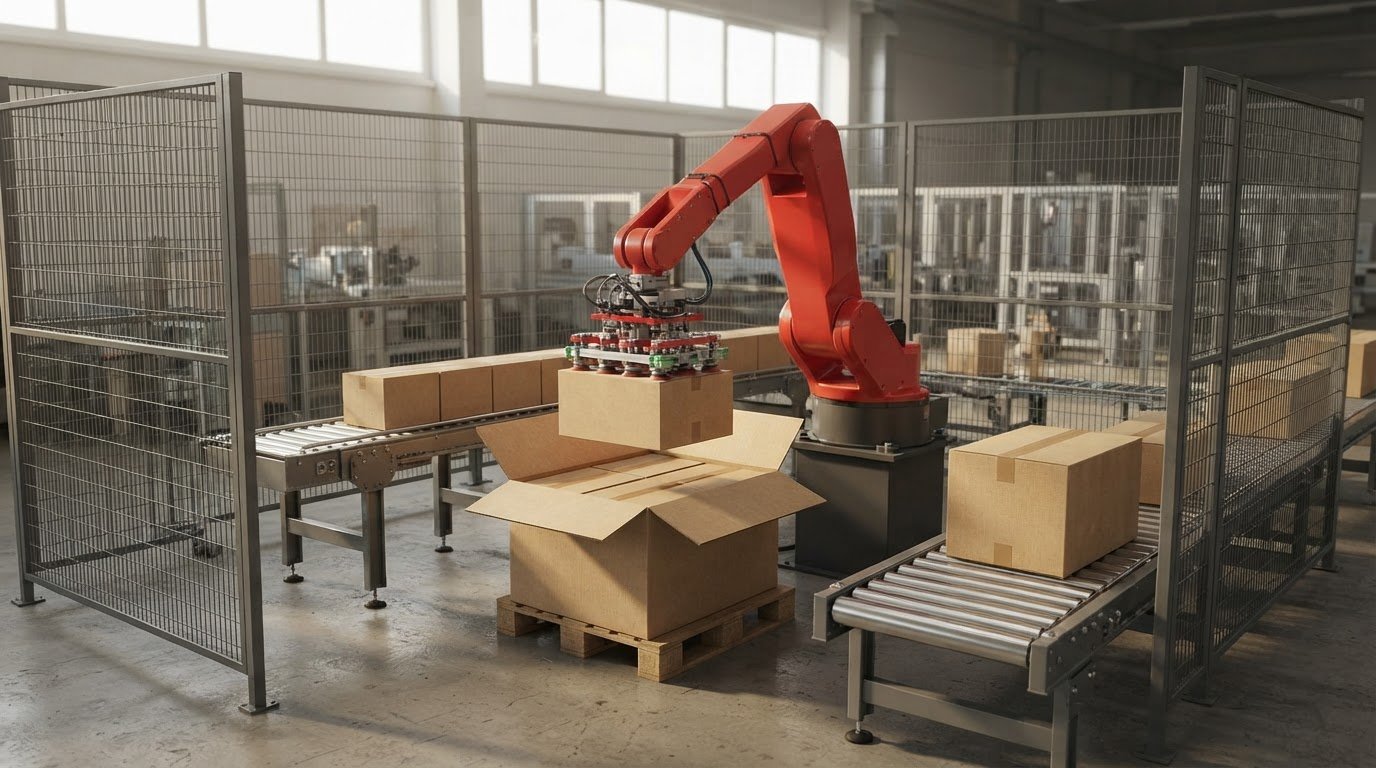
A robotic case-packing cell can help when manual loading limits throughput or frequent product changes make a fixed process difficult to manage. Robotic case packing systems use end-of-arm tooling to pick and place products into cases, with tooling selected for the product type and size. They can handle products from cans and cartons to more delicate items.
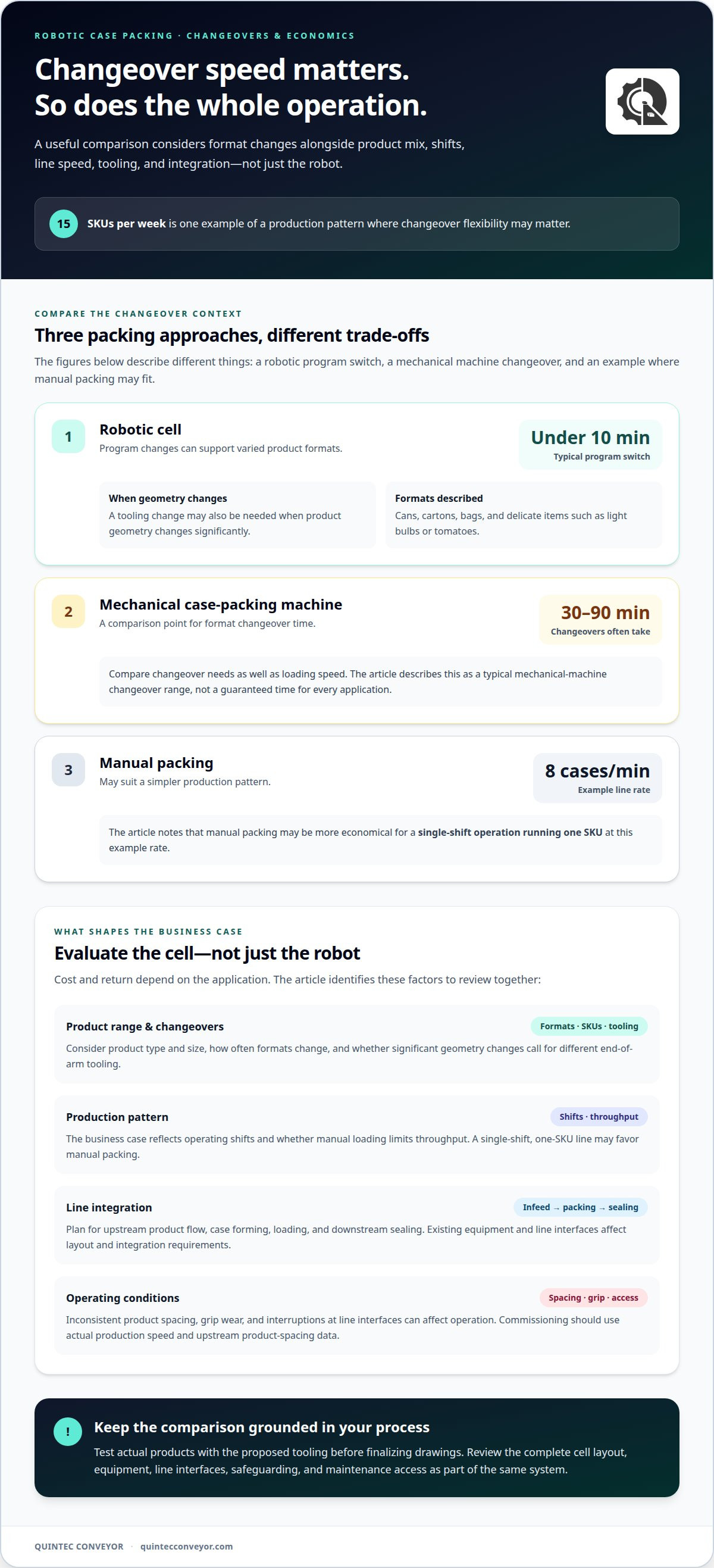
It’s reasonable to expect automation to improve consistency, but the right system must also fit the product, line speed and packaging process. Robotic programs can typically switch in under 10 minutes, while a tooling change may be needed when product geometry changes significantly.
This article explains how robotic packaging automation works at the end of the line, what equipment a case-packing cell may include, and where collaborative robots can fit. It also covers the production conditions that may make automation practical, factors that affect system quality and cost, and how an integration partner can plan around your operation.
Key Takeaways
- Assess product variety and how often formats change to determine whether robotic packing flexibility could support your production needs.
- Plan the case-packing cell as part of the full end-of-line process, including how products arrive, cases are formed, and finished cases are sealed.
- Consider collaborative robots in the context of the task, workspace, and people working nearby; the right approach depends on the cell’s requirements.
- Review the equipment, line interfaces, and facility infrastructure together so the system is designed around your operation rather than as a standalone robot.
Why Choose Robotic Packaging Automation?
Robotic automation can manage varied products and repetitive packing tasks. The right setup depends on product formats, line connections, and production demands.
Flexible Product Format Handling
A robotic packer can handle cans, cartons, bags, and fragile products such as light bulbs or tomatoes. End-of-arm tooling is selected for the product’s type and size, then places it into a carton or other packaging. Programs typically switch in under 10 minutes; a tooling change is needed when product geometry changes significantly. A line running 15 SKUs per week illustrates where changeover flexibility may matter.
Production Line Integration
Integration planning considers both new lines and existing equipment. The cell must match upstream product flow and downstream packaging steps, rather than operate as an isolated machine. If line speed varies, encoder-based conveyor tracking can help the robot follow products in motion. Commissioning should use actual production-speed and product-spacing data from the upstream machine to assess the interface under operating conditions.
Product Loading and Package Handling
Robots can load products for flow wrapping and handle several parts of a package assembly. Depending on the application, end-of-arm tooling may handle the product, an insert, or a clamshell before placing the assembly for packing. Test actual products with the proposed tooling before finalizing drawings. This helps establish whether the gripping and placement approach suits each product and package format.
Cost and Return on Investment
Cost and return depend on the cell layout, tooling, product range, line speed, and integration requirements. The business case also reflects operating shifts and whether manual loading limits throughput. For example, manual packing may be a better fit for a single-shift line with one SKU. Common operational risks include inconsistent product spacing, grip wear, and interruptions at line interfaces. For soft products, schedule vacuum-cup replacement by production cycles rather than calendar time.
End-of-line robotic packaging and case packing
An end-of-line cell coordinates product loading, case forming, and sealing. Its layout should account for the complete packaging sequence, including existing equipment.
Primary and Secondary Package Handling
Primary packaging contains or protects the product; secondary packaging groups those packages into cases. A robot can pick products with end-of-arm tooling and place them into cartons, while an indexing conveyor positions each case for loading. A multi-pick vacuum gripper arranged for a 2×3 array can load six products in one cycle.
Clamshell assembly can also connect to case packing. One cell incorporated an existing clamshell welder, illustrating how automation can work around equipment already on the line. A centralized packaging layout brings the robot, case erector, indexing conveyor, and sealer into one coordinated cell, with guarding, electrical service, and maintenance access included in the plan.
Safety Standards and Regulations
Applicable safety requirements in the United States depend on the equipment, task, and installation. Cell planning should address safeguarding and operator and maintenance access around the robot, case erector, and sealer. The final layout should account for how people interact with the cell during production and servicing, rather than treating the robot as a standalone machine.
System Cost
There is no single price for a robotic case-packing system; price depends on the application and is provided after a quote request. Key cost factors include the robot and tooling, cell layout, case-handling equipment, line integration, and the condition of existing machinery. Return also depends on operating shifts and whether manual loading constrains throughput. A single-shift operation running one SKU at 8 cases per minute may find manual packing more economical.
Compare changeover needs as well as loading speed. Mechanical case-packing machine changeovers often take 30 to 90 minutes, while a robotic cell’s value depends on its product mix and process design. Commissioning should use actual production speed and upstream product-spacing data, so the case-packer interface is evaluated under operating conditions.
Collaborative robot case packing
A collaborative robot can automate repetitive case-loading tasks in a packaging line designed around human work. Its suitability depends on the product, case format, required cycle, and how operators interact with the cell. “Collaborative” describes the robot category; it does not automatically mean people can work beside it without safeguards.
Start with the packing task. For example, a robot may pick packaged units from an infeed and place them into an open case while an operator replenishes packaging materials nearby. The cell design must account for reach, payload, gripping method, and product placement. Fragile cartons or irregular products may require different tooling and handling from stable, uniform packs.
Evaluate the complete operation, not just the robot. Case presentation, conveyor movement, product spacing, and access for loading materials all affect workflow. If the packaging line changes formats, the cell also needs a clear changeover process for the robot program, tooling, and case position. This assessment helps determine whether collaborative automation fits the actual production pattern.
People and equipment should share a work area only when the application is designed for that interaction. A risk assessment should consider the robot’s motion, tooling edges, products, and nearby machinery, including the case erector and sealer. Depending on the cell layout and tasks, guarding or other protective measures may still be needed. The design should also define how operators enter the area for replenishment, adjustments, and maintenance.
Collaborative robots may suit operations where a compact cell and close operator access are priorities, but they are not automatically the right choice for every case-packing task. A high-throughput line may need a different arrangement, while a repetitive loading step with frequent operator involvement may benefit from collaboration. Compare cycle requirements, product handling, workspace, and changeover needs before selecting a robot type.
Robotic case-packing equipment
A case-packing cell is a coordinated machine, not just a robot arm. Core equipment may include the robot, end-of-arm tooling, product infeed, case handling, controls, and safety guarding. A conveyor or palletizer may receive finished cases downstream. Arrange the equipment to suit the product, case pattern, and production flow.
Tooling determines how the robot grips and places each load. Vacuum grippers suit products with accessible, stable surfaces; mechanical grippers can support other shapes and handling needs. Qualify the selected tool using actual products, since surface texture, package stiffness, and placement clearance affect picking reliability. Vision can help identify product position when presentation varies, while consistent spacing supports repeatable motion.
A case erector prepares open cases, and an indexing conveyor positions them for loading. The robot controller coordinates these motions with the upstream line. If conveyor speed varies, encoder-based tracking lets the robot follow products in motion. A sealer can close filled cases before they move to a palletizer, linking case packing to the next material-handling stage.
There is no single typical throughput for every system. The achievable rate depends on product arrangement, picks per cycle, robot motion, case presentation, and upstream feed. For example, the same robot may produce different output rates when loading one item per cycle instead of a grouped pattern. Assess the target across the complete machine sequence, not just the robot’s movement.
In the United States, robotic case-packing equipment is supplied by robot manufacturers and system integrators. Manufacturers provide robot components, while integrators coordinate the robot with tooling, conveyors, case handling, controls, and adjacent machines. A complete equipment review should define these interfaces and include maintenance access, so service tasks do not disrupt production flow.
Quintec Conveyors: Robotics & Automation
Quintec Conveyors supports operations planning robotic packaging automation alongside the conveyors, infrastructure, and additional material-handling equipment that connect a cell to the wider facility. This integrated approach is useful when a new case-packing application must work with existing production flow or when an operation is planning a broader material-handling upgrade.
Bring the product formats, case requirements, line constraints, and desired production outcomes into the project discussion. These details help shape a system around the actual packaging process, including how robotic equipment fits into upstream and downstream operations. For a coordinated approach to robotics and material handling, contact Quintec Conveyors.
Plan the Next Step for Your Packaging Line
Robotic case-packing systems become a practical project when the packaging task connects to the wider production plan. Start by defining the outcome the operation needs, then consider how the cell fits the facility, existing equipment, and material flow. A clear project scope gives engineering decisions a practical operational context.
Quintec Conveyors brings together Robotics & Automation, Conveyors, and Infrastructure for industrial material-handling applications. This combination can help align a packaging cell with the systems around it, rather than treating the robot as a standalone purchase. Share the products, case formats, and line constraints shaping your project to start a focused conversation about the right approach.
Contact Quintec Conveyors to discuss your packaging automation plans. A well-defined next step can move your operation toward a more connected end-of-line process.
Frequently Asked Questions
What are robotic case packing systems and how do they work?
Robotic case packing systems use a programmed robot to transfer products into shipping cases in a defined arrangement. The cell coordinates product supply, case positioning, and robot movement so each case receives the intended load. For example, a line may group retail packs into a case pattern before moving the filled case onward. The gripping method and placement sequence depend on the product and packaging design.
What types of robotic case packers are available, and how do they differ?
Robotic case packers vary by robot configuration, loading pattern, end-of-arm tooling, and how they fit the line. A collaborative robot may suit a work area with close operator involvement, while another industrial robot arrangement may better suit different reach or cycle requirements. These categories alone do not determine suitability. Product presentation, case opening, placement pattern, and available floor space shape the system design.
Which products and case formats can robotic case packing systems handle?
Robots can handle a range of products and packaging formats when the tooling and loading sequence suit the application. Assess product dimensions, weight, surface, and how items arrive at the cell. Case details matter too: opening size, internal arrangement, and whether products need inserts or protective packaging. For mixed product lines, qualify each format rather than relying on a single sample.
How do robotic case packers compare with conventional and manual case packing systems?
Robotic packing offers programmable handling, while conventional mechanical machines use dedicated mechanisms and manual packing relies on operators to load cases. The better fit depends on product variety, changeover frequency, line demands, and available labor. A stable product mix may suit a dedicated mechanical process; frequent format changes may favor programmable handling. Manual packing can remain appropriate when automation would add complexity without addressing a production constraint.
What steps do professionals take to select, integrate, and commission a robotic case packer, and what information should clients provide?
Define the packing task, evaluate product and case formats, plan equipment interfaces, and test the proposed process during commissioning. Useful project inputs include product samples, case drawings, a SKU list, target production rates, and a facility layout showing existing equipment. Details about upstream product presentation and downstream case handling help the integration team design a cell that fits the complete line.
What is the typical speed and throughput of a robotic case packing system?
There is no single typical throughput. The achievable rate depends on product arrangement, pick count per cycle, robot motion, case presentation, and upstream feed; a 2×3 vacuum gripper can load six products in one cycle.