

A weak RFP can make competing proposals impossible to compare. To understand how to write a material handling system RFP, start by documenting current processes, then define the project scope, operating requirements, and safety expectations clearly enough for vendors to prepare informed proposals.
It’s easy to focus on equipment and future goals, but the existing operation matters just as much. Current rates, handling methods, and facility conditions shape what a practical solution needs to address. This guide explains how to document that baseline, set measurable requirements, and clarify the project scope. It also covers evaluation criteria and site visits, so you can assess proposals on more than price alone.
Key Takeaways
- Document the operation’s current handling methods and rates so proposals start from a shared, practical baseline.
- Separate essential safety and compliance requirements from preferences, and define how each will be evaluated.
- Clarify what the project includes, how bids will be scored, and which assumptions vendors should explain in their proposals.
- Use a site visit and structured bidder questions to surface facility constraints that could affect system design and installation.
1. Compliance and safety requirements
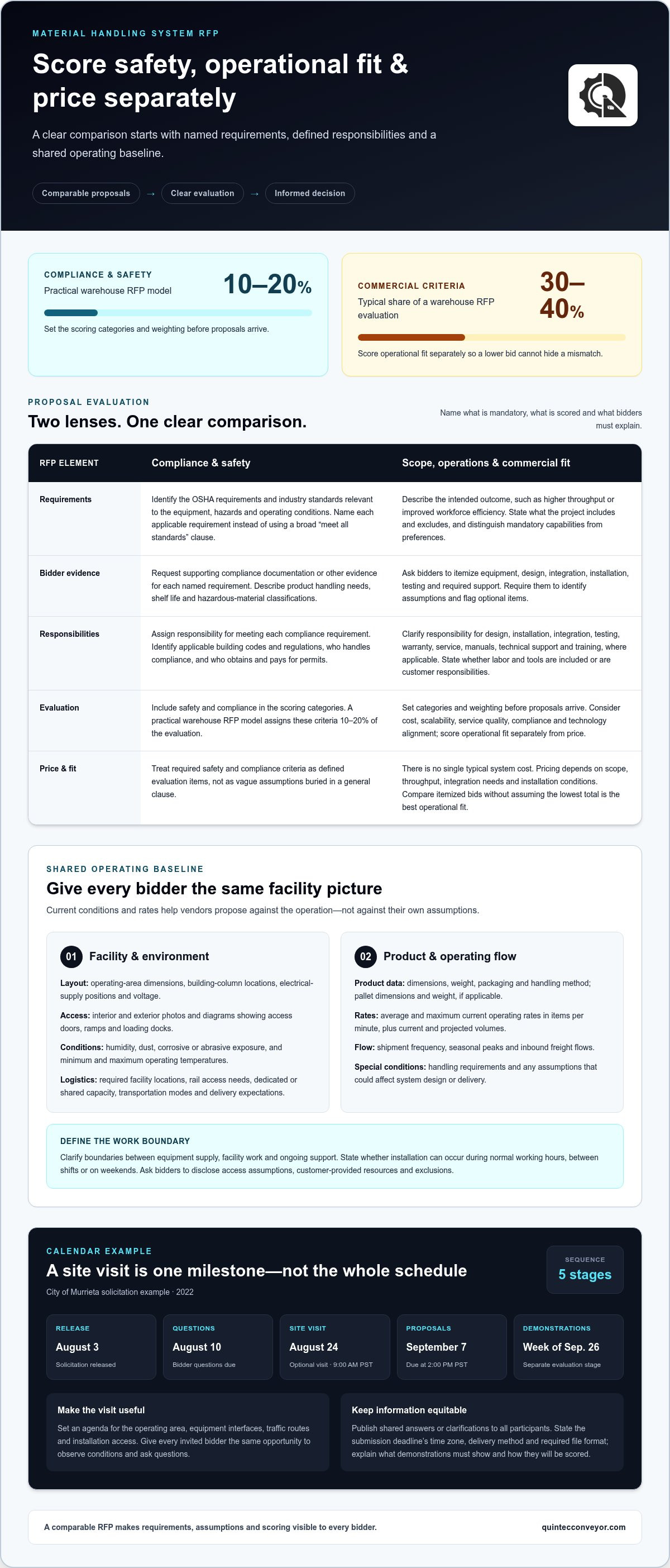
Identify the OSHA requirements and industry standards relevant to your equipment, hazards, and operating conditions. Name each requirement in the RFP, specify the compliance documentation bidders must provide, and assign responsibility for meeting it. Avoid a broad “meet all standards” clause. Instead, identify the requirement that applies to the conveyor’s operating area and request supporting evidence. The RFP should also describe product handling needs, shelf life, and hazardous-material classifications.
For manufacturing logistics, distinguish mandatory capabilities from preferred features. Describe required facility locations, whether rail access is needed, and whether capacity must be dedicated or can be shared. Specify transportation modes and delivery expectations, then list applicable compliance requirements and documentation expectations. These details help vendors develop proposals around actual operating conditions rather than assumptions.
Give bidders a useful facility and product profile. Include operating-area dimensions, building-column locations, and electrical-supply positions and voltage. Attach interior and exterior photos and diagrams showing access doors, ramps, and loading docks. Describe humidity, dust, corrosive or abrasive exposure, and minimum and maximum operating temperatures. For product data, provide dimensions, weight, packaging, handling method, and pallet dimensions and weight, if applicable. State current and projected volumes, shipment frequency, seasonal peaks, inbound freight flows, and special handling conditions.
Set the schedule and scoring method in the solicitation. Define question and proposal deadlines, site-visit timing, evaluation stages, and the planned decision timeline; leave enough time for bidders to assess the facility and prepare responses. Set scoring categories before proposals arrive, including safety, compliance, operations, technology, and commercial fit. A practical warehouse RFP model assigns 10-20% of evaluation to compliance and safety criteria. Describe the operational outcome sought, such as higher throughput, and provide average and maximum current operating rates in items per minute. That baseline gives each proposal a comparable performance target.
List the OSHA requirements and industry standards relevant to the facility’s equipment, hazards, and operating conditions. Name each requirement rather than relying on a broad clause. For example, identify the requirement relevant to the conveyor’s operating area, request compliance documentation or other evidence from bidders, and assign responsibility for meeting each requirement.
2. Avoiding price-only decisions and ambiguous scope
There is no single typical cost for a material handling system. Pricing depends on project scope, throughput, integration needs, and installation conditions. Ask bidders to itemize equipment, design, integration, installation, testing, and required support; identify their assumptions; and flag optional items. This makes proposals easier to compare without treating the lowest total as the best operational fit.
Define requirements by describing the intended result, such as improving workforce efficiency or increasing throughput. Then state what the project includes and excludes. Identify responsibility for design, installation, integration, testing, warranty, service, manuals, technical support, and training, where applicable. Clarify whether installation labor and tools are included in the vendor’s scope or remain customer responsibilities. Also identify applicable building codes and regulations, who handles compliance, and who obtains and pays for permits.
Ask each bidder to summarize relevant company experience, proposed project roles, and the personnel responsible for installation and future maintenance or warranty claims. Set evaluation categories and weighting before proposals arrive. Consider cost, scalability, service quality, compliance, and technology alignment. Commercial criteria, including price, typically account for 30-40% of a warehouse RFP evaluation. Score operational fit separately, so a lower bid cannot obscure a mismatch with required capacity or project responsibilities.
For warehouse operations, describe the services needed and define boundaries between equipment supply, facility work, and ongoing support. State whether installation can occur during normal working hours, between shifts, or on weekends. Ask bidders to disclose any assumptions about access, customer-provided resources, and exclusions that could affect delivery. If warehouse racking or additional equipment forms part of the project, specify its role in the system scope. Clear equipment and infrastructure requirements help vendors develop comparable proposals. Material handling equipment planning can help frame those requirements around the operation.
3. Pre-proposal conference and site visit
A request for proposal needs a clear calendar, not just a submission date. Set milestones for release, bidder questions, site access, addenda, proposals, demonstrations, evaluation, and award. Leave time between each stage to issue shared answers and let bidders revise their responses. The City of Murrieta’s 2022 solicitation shows how specific that sequence can be: it was released August 3, with questions due August 10.
Use a site visit to reveal practical constraints that drawings may miss. In Murrieta, the optional pre-proposal visit was scheduled for August 24, 2022, at 9:00 AM PST. Provide a defined agenda covering the operating area, equipment interfaces, traffic routes, and installation access. Give every invited bidder the same opportunity to observe conditions and submit questions. Publish answers or clarifications to all participants so no proposal gains an information advantage.
State the submission deadline with its time zone, delivery method, and required file format. Murrieta’s proposals were due at 2:00 PM PST on September 7, 2022. The solicitation also scheduled bidder demonstrations for the week of September 26, 2022. Treat demonstrations as a distinct evaluation stage: explain what bidders must show, who will attend, and how the presentation will be scored. Keep the proposal deadline separate from demonstration dates.
Explain how alternative proposals should be presented. Require a compliant base response first, then allow alternatives in a separate section with supporting documentation. That format lets evaluators compare the requested solution consistently while considering a bidder’s proposed improvement. Include an addendum process and require acknowledgement of each issued change. In Murrieta’s RFP, proposers had to acknowledge receipt of Addendum #1; failure could subject a firm to disqualification. A controlled schedule, common site information, and clearly separated alternatives make each submission easier to assess.
Existing material handling processes
Start with a process map showing how material moves from receipt to its next destination. Record every handoff, loading method, buffer, and manual movement. For example, trace a pallet from the receiving dock through staging, storage, picking, and dispatch. Add the quantity handled at each stage so bidders can see where work accumulates. Pair a written sequence with a simple floor-plan sketch to give vendors a shared view of the operation.
Measure the baseline before defining the future system. Provide average and maximum current operating rates in items per minute, and explain which process stage each rate represents. Separate normal conditions from peak periods and identify the time window behind each measurement. If a line slows during changeovers or product variation, describe the condition and its effect on flow. This context helps bidders distinguish a capacity constraint from a temporary interruption.
Describe how operators load, transfer, and unload products today. Specify quantities handled, packaging types, and whether movement involves pallets, containers, or individual items. Explain where workers manually reposition loads, wait for equipment, or redirect material. Include exceptions, such as oversized products taking a different route through the facility. Mark those routes and relevant work areas on a process diagram, rather than showing only the intended main flow.
Connect the baseline to the required outcome. Identify the bottleneck the project must address, then state how the new system should improve that process. For example, if receiving queues before storage, describe the queue location and the affected handoff. Separate observed facts from future targets, so proposals respond to the same starting conditions. Use the documented flow to develop a process engineering approach that reflects actual facility operations.
Quintec Conveyors: Conveyors
Quintec Conveyors can help translate your RFP requirements into a material handling project scope. Involve the team when your review of current processes points to a need for conveyor integration, robotics and automation, infrastructure, or additional material handling equipment.
A clear baseline gives project discussions a practical starting point: current material flows, operating rates, facility constraints, and the outcome your operation needs. These details help define system requirements and identify where equipment and infrastructure must work together. If the project includes conveyors, defining these interfaces early can support a coordinated approach from design through installation.
When your scope and priorities are taking shape, contact Quintec Conveyors to discuss your material handling project.
Turn the RFP into a project starting point
An RFP can do more than collect bids. Use it as the working document for aligning operational priorities, technical decisions, and project ownership. When responses arrive, apply the same requirements and evaluation framework to identify differences between proposals, assumptions that need discussion, and decisions your team must make before moving forward. This keeps procurement aligned with the facility’s long-term operating needs.
Knowing how to write a material handling system RFP means creating a decision process that continues beyond submission day. Bring your project priorities and draft scope to the next conversation, and consider how conveyors, robotics and automation, or infrastructure could fit your operation. Quintec Conveyors can discuss how these needs relate to a material handling project.
Contact Quintec Conveyors about your project and take the next step with a clearer path forward.
Frequently Asked Questions
How to write performance requirements and acceptance criteria for material handling equipment?
To write a material handling system RFP with clear acceptance criteria, define observable pass-or-fail outcomes tied to operating tasks. Identify test material, feed conditions, required flow path, and measurement method, then state what evidence will satisfy each criterion. For example, require a demonstration using representative products under agreed operating conditions. Separate functional acceptance from documentation, operator instruction, and resolution of outstanding corrective work.
What questions should a material handling system RFP ask vendors about automation and integration?
Ask vendors to map proposed automation to your current software and controls. Which systems exchange data, what information passes between them, and how are errors surfaced? Request a responsibility matrix for interface design, testing, and troubleshooting. Ask what operators see during a connection interruption and how normal operations resume. A useful response identifies dependencies and customer-provided components instead of simply claiming integration capability.
How to compare material handling system proposals and vendor qualifications?
Compare every proposal against the same compliance matrix, then assess the team and supporting evidence. Request three client references with similar volumes and product characteristics, along with examples of comparable project scope. Review proposed roles, relevant experience, assumptions, and documented deviations. Evaluate qualifications separately from technical compliance and commercial terms. This helps distinguish a complete, well-supported response from one that relies on presentation quality alone.
What implementation timeline, commissioning, training, and support requirements should an RFP specify?
Build the schedule around design approval, procurement, custom manufacturing, installation access, commissioning, and operational handover. Ask vendors to identify dependencies and the decisions your team must provide at each milestone. Define which commissioning records demonstrate completion, who resolves defects, and how training, manuals, technical support, and maintenance responsibilities transfer. For phased installation, request a sequence that shows how existing operations remain accessible between work stages.
What risks and common mistakes should be avoided when writing a material handling system RFP?
Common risks include describing only a future state, using inconsistent units, and leaving product variations or interface ownership implicit. These gaps can lead vendors to make different assumptions, undermining comparisons and creating scope disputes. Maintain a controlled source for drawings and revisions, record bidder questions and shared answers, and separate alternatives from the compliant base response. This creates a clear record as decisions evolve.
What safety, OSHA, and industry standards should a material handling system RFP reference?
List the OSHA requirements and industry standards relevant to your facility’s equipment, hazards, and operating conditions. Name each requirement, request compliance documentation or other evidence from bidders, and assign responsibility for meeting it.