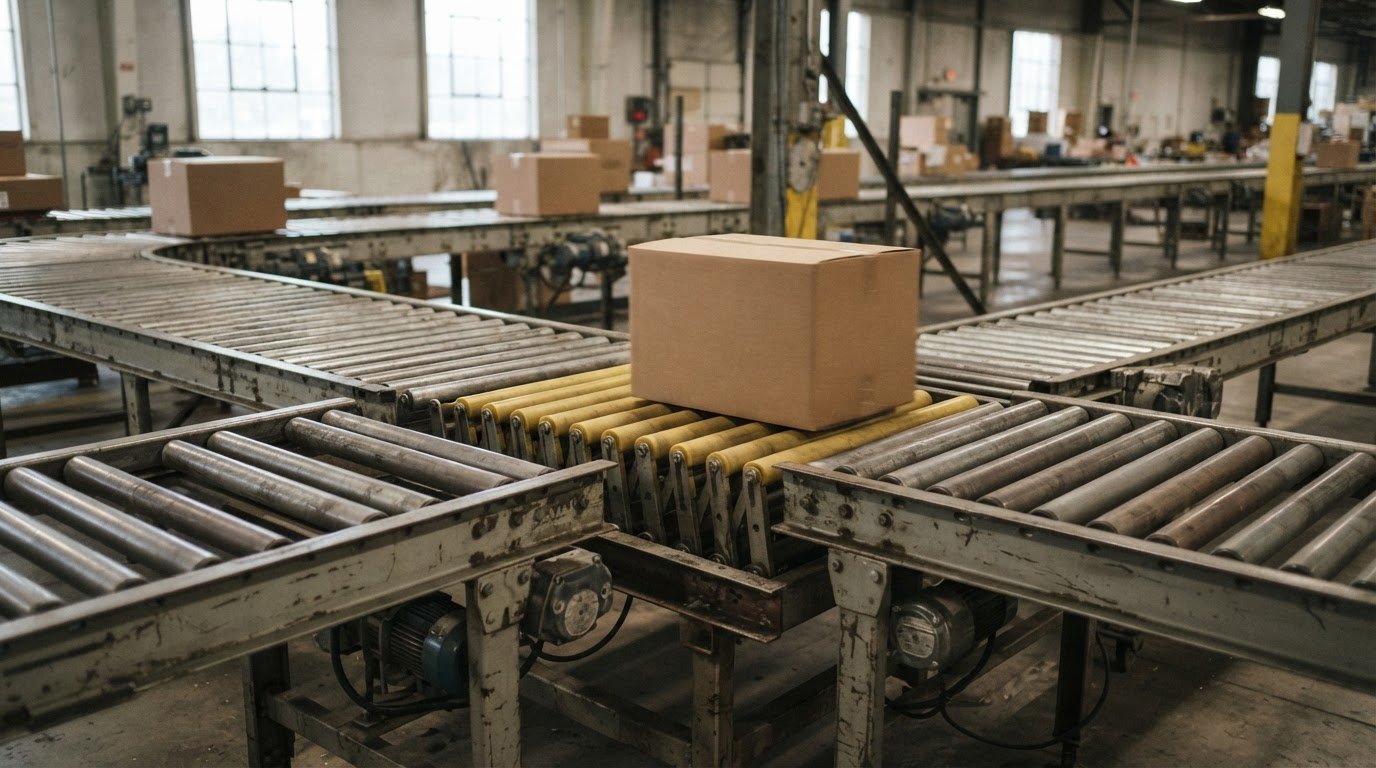
A conveyor’s most important movement may happen sideways, not forward. Conveyor transfer rollers move flat-bottomed items between conveyor sections, helping a line change direction, merge or divert products, or connect adjacent processes. A 90-degree transfer redirects products from one conveyor line to another.
A change in direction may look simple, but reliable movement depends on matching conveyor transfer rollers to the product and surrounding layout. Roller systems commonly move boxes, cartons, and pallets through manufacturing, warehousing, and packaging facilities.
This guide explains how transfer rollers work, where automated production lines use them, and what can disrupt a transfer. It also covers how transfer arrangements support facility flow, why roller structure and control logic need to align, and what to consider when planning an integration. With this foundation, you can identify the role each transfer point should play in the wider material-handling system.
Key Takeaways
- Identify whether a transfer point needs to move items straight ahead, redirect them, merge flows, or divert products.
- Understand how powered and gravity roller systems support different movement requirements in automated lines.
- Recognize how mismatched transfer direction, roller structure, or control logic can disrupt product flow.
- See when conveyor maintenance and system integration can help address transfer issues within a facility.
Common applications in automated production lines
Automated production lines use transfer rollers to redirect products, merge flows, divert items, or connect conveyor sections. A straight transfer moves items between aligned lines. A 90-degree transfer changes their direction onto another line. These layouts can reduce manual repositioning between processes. In a space-limited facility, a 90-degree connection can link adjacent operations without extending the conveyor as far. For example, a packaging line can route cartons toward a side inspection station.
A professional selects roller size, material, and load capacity based on the products and operating conditions. Key factors include the package footprint and underside, weight, transfer direction, and load distribution. A flat-bottomed carton and a pallet with narrow support boards need different support across a transfer point. Roller structure and spacing must suit the item as it moves between conveyor sections. Material selection also depends on the facility environment and application.
Parcel and e-commerce operations use transfer points to connect receiving, sortation, packing, and dispatch. Cartons may move from a takeaway line to a side feed, merge with parcels from another lane, or divert toward a destination. A 90-degree transfer can connect conveyor runs in a compact sort area. Because parcel footprints vary, the transfer must support the items through the handoff. The design also needs to match the direction of travel at each connection.
A common sourcing mistake is choosing equipment by conveyor width alone. A transfer suited to one carton may not support pallet loads or mixed package footprints. Another mismatch occurs when the transfer direction, roller structure, and control logic aren't aligned. A loading zone, straight section, 90-degree transfer, and pallet transfer point may each need a different structure. To match the application, the integration professional maps item types, flow direction, merge or divert points, and receiving conveyor conditions. This links the selected transfer to the production sequence, not just one handoff.
Automated production lines can use transfer rollers to reduce manual handling, so operators do not have to reposition every item by hand.
What Are Conveyor Transfer Rollers?
A roller conveyor uses cylindrical rollers that rotate to move objects along its frame. At a transfer point, the rollers support a load as it passes between sections or changes direction. For a smooth handoff, the incoming and receiving surfaces need to align with the item’s base. A flat-bottomed carton, for example, can roll across a straight section when its base remains supported.
Powered rollers use a drive system to move products along the conveyor. They suit controlled movement through a line, such as advancing cartons toward a sensor or the next process. Gravity rollers rely on a sloped path or an external push. A gravity section can connect work areas where powered movement is unnecessary, while a powered section can maintain movement through an automated sequence. Choose based on the required flow, product characteristics, and connection to adjacent equipment.
Ball transfer units support movement differently from roller units. Cylindrical rollers generally guide items along a set path, while omnidirectional ball bearings allow flat-bottomed items to move in different directions with little resistance. For example, ball units on a work surface can let an operator reposition a carton sideways, while rollers suit travel along a defined route.
Gravity options include straight sections and transfer points designed to redirect or reposition loads. The slope, support, and connection to the next section affect how smoothly an item moves. A carton that stops short may need a different layout from a pallet moving between aligned sections. Match the transfer to the load and route to avoid awkward handoffs.
Potential safety risks include contact with moving components, pinch points, and unexpected movement during maintenance. An OSHA compliance review should consider equipment layout, access to moving parts, guarding, controls, and maintenance tasks. Applicable requirements depend on the conveyor and work activity, so evaluate these conditions together. Quintec prioritizes employee safety and follows all OSHA requirements and regulations.
A conveyor system assessment can bring roller selection, transfer geometry, and controls into one design review.
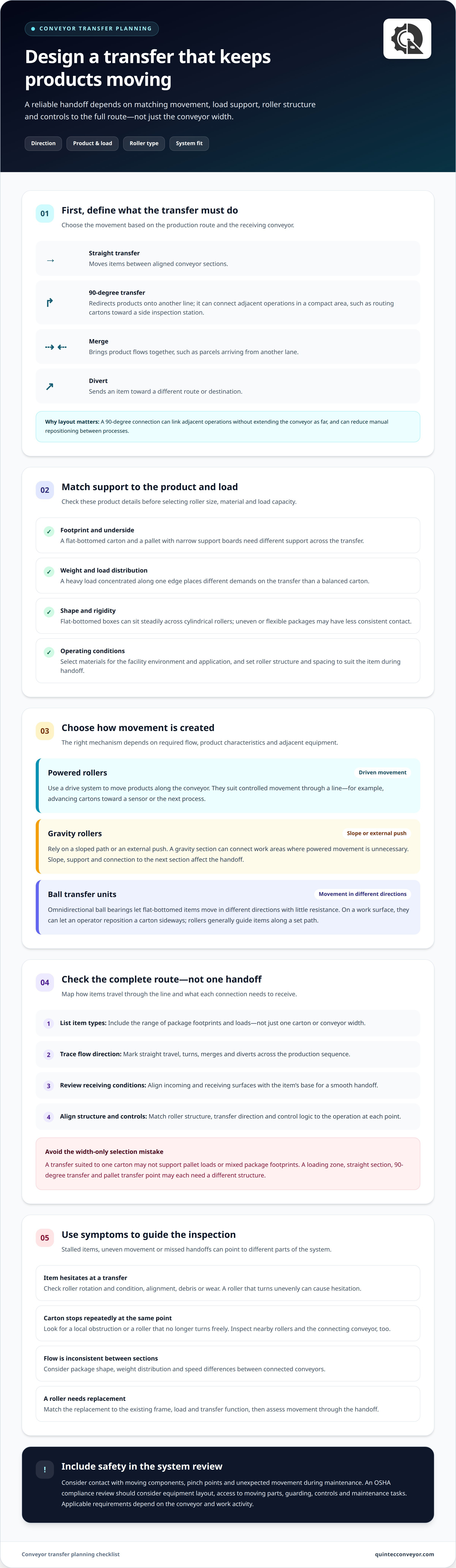
Common roller transfer problems
Transfer faults often show up as stalled items, uneven movement, or missed handoffs. A professional traces each symptom to the rollers, product, alignment, or control sequence.
Maintenance and Roller Replacement
Maintenance involves inspecting roller condition, checking for debris or wear, and assessing alignment and rotation. A roller that turns unevenly, for example, may cause hesitation at the transfer point.
When a roller needs replacing, match the new component to the existing frame, load, and transfer function, then assess movement through the handoff. This helps prevent a replacement from creating a new alignment or support problem.
Debris can collect around rollers and restrict movement, while worn or damaged components can provide inconsistent support. A carton that repeatedly stops at the same point may indicate a local obstruction or a roller that no longer turns freely. Examine that location alongside nearby rollers and the connecting conveyor, rather than assuming every stoppage is an isolated part failure.
Performance Across Packages and Speeds
Performance varies with package shape, weight distribution, and conveyor speed. A flat-bottomed box can sit steadily across cylindrical rollers, while an uneven or flexible package may have less consistent contact. A heavy load concentrated along one edge also places different demands on the transfer than a balanced carton.
Speed differences between connected sections can interrupt flow. If an upstream conveyor advances packages faster than the receiving section carries them away, items may bunch at the handoff. If the receiving section moves faster, gaps can open between packages. Professionals assess actual product movement across each transition, including the slowest or least stable package in the mix.
Other symptoms can help narrow down the cause. A parcel that shifts sideways may indicate poor alignment or unsuitable support at the transfer. Repeated hesitation can point to friction, a damaged roller, or a mismatch between control timing and movement. Assess these clues together under normal operating conditions. This connects the repair to the process issue instead of simply replacing a visible component.
Transfer roller definitions and role in material handling
A transfer roller assembly supports products as they pass between conveyor sections or pieces of equipment. Cylindrical rollers turn beneath an item, creating a moving support surface within a frame. In a facility, the transfer point bridges separate operations. For example, a line can carry a workpiece from assembly toward inspection without requiring an operator to carry it between stations.
A transfer does more than move an item. When integrated effectively, it maintains the intended route, supports the load during handoff, and connects equipment into a continuous material-handling process. At a packaging station, the transfer must deliver a carton where the next process can receive it. At a palletizing area, the layout must account for how the pallet approaches and leaves the transfer.
Transfer points can support different functions within a facility’s flow:
- Continue movement: aligned rollers carry products between connected conveyor sections.
- Change route: a transfer directs products toward another process or destination.
- Connect equipment: a roller section links machinery with upstream or downstream handling.
These functions affect the wider system. If a receiving conveyor is misaligned, products may hesitate or shift during handoff. If a process requires items to arrive in a particular sequence, the transfer’s controls and direction must support that sequence. Start the design with the task, product path, and equipment on both sides, rather than treating the roller assembly as an isolated component.
For facility planners, the key is to define what each transfer must accomplish within the complete material flow. Map the route from receiving through processing to dispatch, then mark each connection, change of direction, and handoff. This reveals where roller support fits and where another handling method may be more suitable.
Discuss a material-handling system assessment to connect transfer requirements with the wider facility layout.
Quintec Conveyors: Conveyor Maintenance
Quintec Conveyors provides conveyor maintenance for facilities dealing with worn rollers, inconsistent transfers, or recurring interruptions. A maintenance assessment can help determine whether a problem is limited to a roller or tied to alignment, controls, or adjacent equipment. This is especially useful when products hesitate at handoffs or replacing a component does not resolve the issue.
For broader operational changes, Quintec Conveyors also provides conveyors, robotics and automation, and infrastructure solutions. Considering these elements together can connect transfer requirements with the wider material-handling layout. To discuss a project, describe the affected transfer point, the products moving through it, and the operational issue.
Contact Quintec Conveyors to discuss conveyor maintenance for your facility.
Plan the Next Step for Your Material Flow
Use the transfer point as a starting point for broader facility planning. Consider how the route may need to accommodate different products, new process connections, or changing automation requirements. This helps determine whether an adjustment belongs at one handoff or across the larger system.
Quintec Conveyors provides conveyors, robotics and automation, and infrastructure for industrial applications. These solutions can support planning when transfer requirements intersect with equipment integration or facility layout. Start by outlining the transfer location, the products moving through it, and the operational change you want to address.
Thoughtful planning gives your team a practical foundation for future material-flow decisions. For support connecting conveyor transfer rollers to wider facility requirements, start a conversation with Quintec Conveyors.
Frequently Asked Questions
What are conveyor transfer rollers and how do they work?
Conveyor transfer rollers support items as they cross a connection between material-handling equipment. As each roller turns, it helps move the item through the transfer point without a separate manual handoff. For example, a production line can use a roller section to bridge the gap between a machine discharge and a downstream conveyor. The design must suit the item’s base and the equipment interface.
What types of conveyor transfer rollers are available?
Common options include powered rollers, gravity rollers, and ball transfer units. Powered rollers drive movement, while gravity rollers rely on a sloped path or an external push. Ball units allow movement in multiple directions, which can help at a workstation where items need repositioning. Selection depends on the route, how products move, and how the transfer connects to surrounding equipment.
How are transfer rollers installed on a conveyor?
A professional installation starts with a review of the conveyor frame, product path, and transfer purpose. The team then fits the transfer assembly to the surrounding equipment and integrates relevant controls when required. A replacement section, for example, must match the incoming and receiving conveyor interfaces so products can pass between them. Assess the completed installation by observing product movement across the handoff.

Article by
Jon Huang