A magnet can address a separation task, but the conveying system determines how material reaches it and moves on. The Bunting Magnetics and Quintec Conveyors partnership is best considered as a material-handling question: how to integrate separation equipment with conveyors and the facility’s wider workflow.
Reliable material movement depends on more than choosing a single piece of equipment. Belt speed, product flow, facility layout, and connections between process stages all affect how a system works in practice.
This guide explains how conveying systems support material handling, what to consider when integrating separation equipment, and how system design connects individual components. It covers practical decisions and how conveyor integration, automation, and process engineering can address facility needs.
Key Takeaways
- Plan conveying around the full material flow so separation equipment fits into the process, rather than treating it as a standalone component.
- Understand how the SSSC Stainless Steel Separation Conveyor’s optional variable frequency drive supports belt speeds between 60 and 200 feet per minute.
- Identify how equipment construction and sideguards factor into choosing an industrial conveyor for a material-handling application.
- Explore how conveyor maintenance, infrastructure, and automation can support an integrated material-handling system.
Conveying systems for material handling
Material handling works best when conveying and separation are planned as connected process steps. A conveyor moves material through a facility, while separation equipment acts on that flow.
Industries and Applications
Applications include transferring material between process stages and presenting it to separation equipment. The right arrangement depends on the material, its route through the facility, and where separation fits. For an industrial project in the United States, map each transfer point and process handoff. This reveals where conveying must support steady movement and where equipment needs to interact with the material.
Consider partnership applications by process need, rather than assuming a fixed list of industries. A production line may need material moved toward a separation step, while a facility redesign may need that step connected to an existing route. Start by mapping the material’s path and intended processing sequence.
Customer Benefits
Coordinating conveying with separation clarifies how process stages relate. Rather than treating each machine as an isolated purchase, plan how material enters, passes through, and leaves the separation point. This helps inform decisions about equipment placement and system connections.
Evaluate the demands of the specific application before selecting a configuration. Consider material flow, available layout, transfer points, and the intended separation task together. These factors help define system requirements, but they do not establish one design or outcome for every facility.
Public partnership pricing isn’t provided as a fixed figure; project costs depend on the case and are given after a quote request. Scope, layout, equipment selection, and integration needs shape the project requirements.
The market covered here is the United States. Actual application planning still centers on the facility’s process, layout, and material flow.
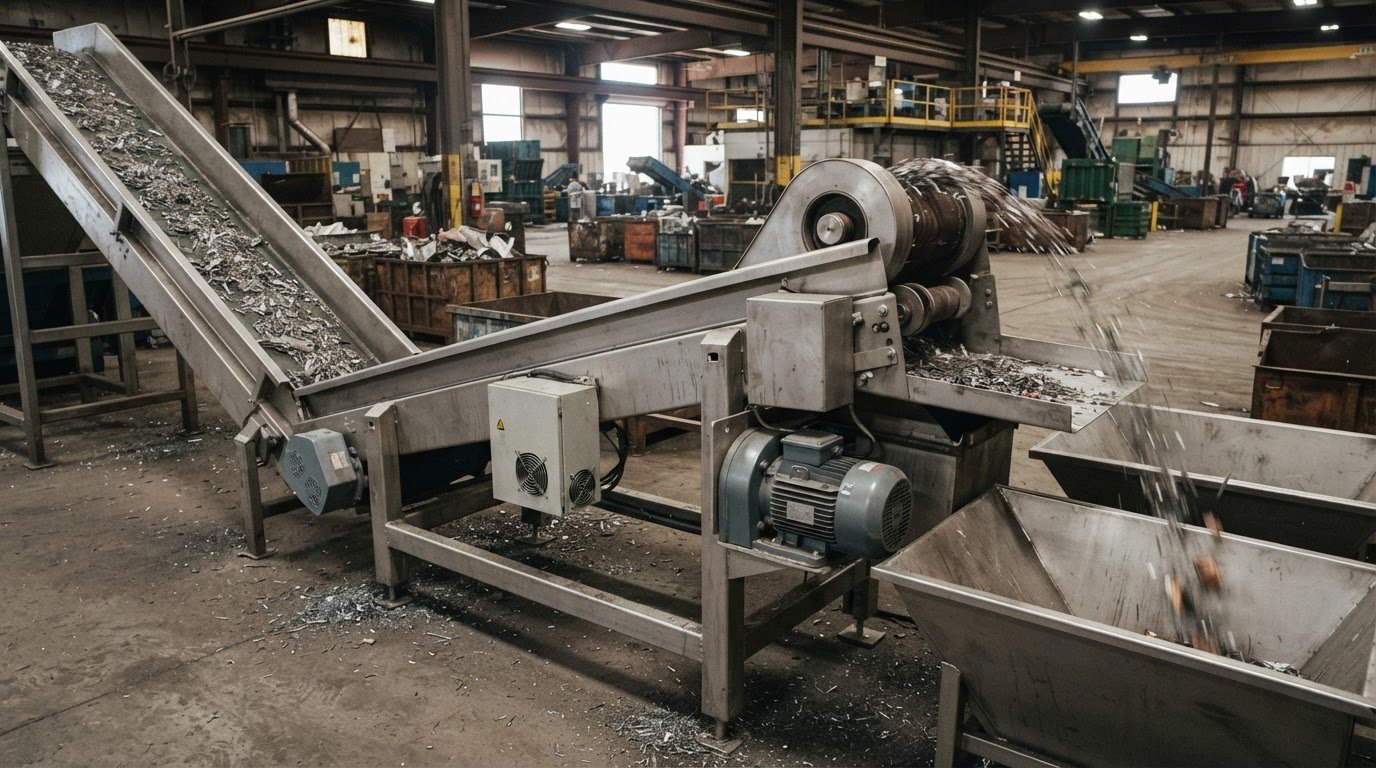
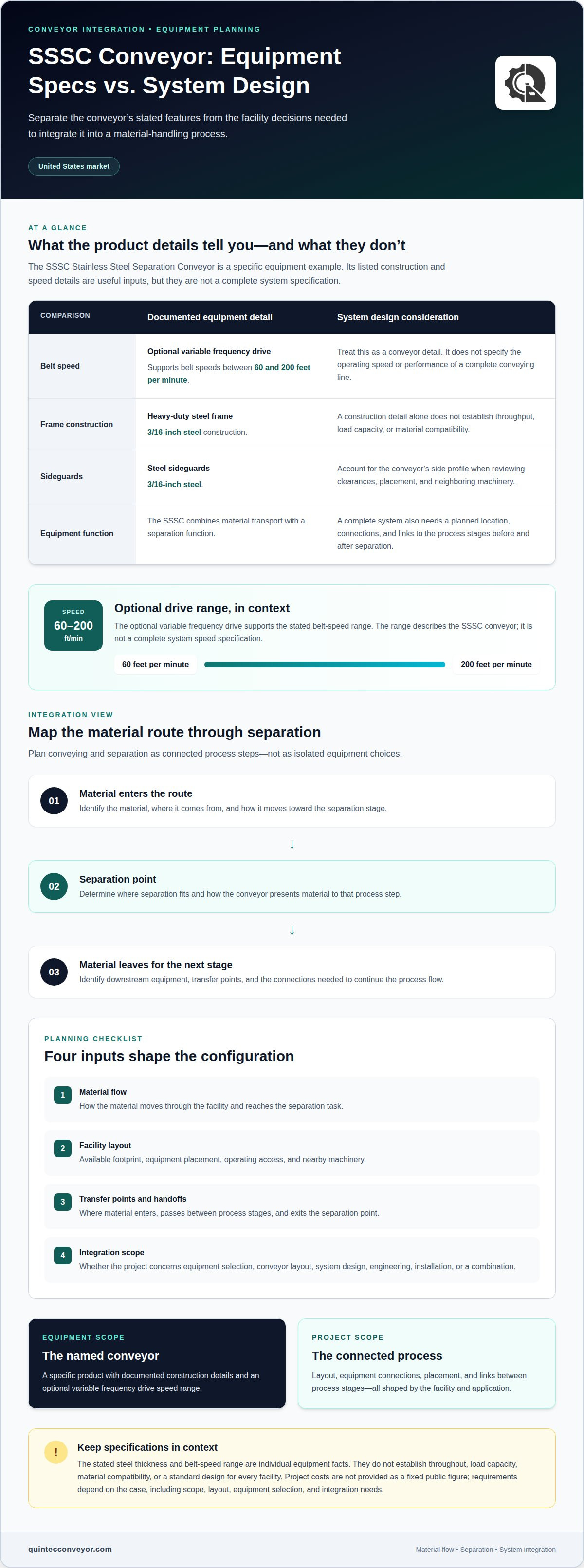
A product relevant to this discussion is the SSSC Stainless Steel Separation Conveyor. It has an optional variable frequency drive for belt speeds between 60 and 200 feet per minute. This product detail describes the conveyor, not a complete system specification.
For partnership product inquiries, contact Bunting or Quintec through their business contact channels. A clear inquiry can identify the application, material route, and separation stage under consideration.
Industrial conveyor equipment
The SSSC Stainless Steel Separation Conveyor provides a concrete example of industrial conveyor construction. Its frame uses heavy-duty 3/16-inch steel construction, while its sideguards are also 3/16-inch steel. Those details identify material thickness, not the conveyor’s complete operating limits or suitability for every facility.
For equipment selection, start with the task at the conveyor’s position. Identify where material enters and exits, and whether separation occurs during transport. Then consider the available footprint, operating access, and connections to adjacent process equipment. These details help define the required configuration without assuming a standard layout.
The SSSC’s 3/16-inch sideguards are a specific construction feature to consider during layout planning. Their presence makes the equipment’s side profile relevant to clearances and neighboring machinery. A design review should account for the conveyor’s placement, transfer points, and surrounding equipment, rather than treating the listed thickness as a measure of overall system capacity.
Equipment specifications should be read as individual facts. For example, 3/16-inch steel construction describes a structural detail; it does not establish throughput, load capacity, or material compatibility. Those requirements depend on the application and the system design. Separating documented construction from process assumptions supports a more accurate technical discussion.
Before integrating an industrial conveyor, map the material route and identify each handoff. Note the equipment before and after the separation point, along with any space constraints that shape installation. For an SSSC application, keep the equipment’s stated details in context while designing the broader arrangement around the facility.
Keep equipment requirements distinct from system requirements. The SSSC Stainless Steel Separation Conveyor is a named piece of equipment; a complete conveying line also involves connections, placement, and links to other process stages. Reviewing these elements helps teams define a practical scope without assuming unsupported specifications.
What products or services does the partnership cover?
The SSSC Stainless Steel Separation Conveyor is a specific equipment example associated with magnetic separation and conveying. It combines material transport with a separation function, making it relevant when material must move through a process and encounter separation. Treat it as an example, not a complete catalogue of products or project services.
In the context of the Bunting Magnetics and Quintec Conveyors partnership, distinguish product scope from project scope. The SSSC is a piece of equipment; a material-handling project may also involve conveyor layout, system design, engineering, and installation. These activities address how equipment fits into a facility, where material enters and exits, and how process stages connect.
Start planning with the application. Identify the material route, the separation point, and the equipment before and after it. For example, a conveyor feeding a separation stage needs to fit the process flow and available layout. These details help define whether the project centers on equipment selection, system integration, or both.
Industrial conveyor systems can also involve supporting equipment and infrastructure, depending on the facility’s process and the connections needed between stages. A useful project scope distinguishes the named conveyor from surrounding system requirements, so one component’s specifications are not mistaken for a description of the entire installation.
A custom conveyor project can include design, engineering, and installation. Design establishes the arrangement, engineering develops system requirements, and installation puts the planned equipment in place. The work follows the project scope. These steps show how the Bunting Magnetics and Quintec Conveyors partnership may relate to a facility project without implying a standard configuration.
Keep the distinction clear: the SSSC Stainless Steel Separation Conveyor is the named product example, while conveying, separation, and integration describe different parts of a material-handling solution. This helps facility teams frame requirements accurately and discuss how the equipment relates to their process.
How does Quintec Conveyors distribute or integrate Bunting magnetic separation equipment?
Integration means planning how separation equipment fits within a larger conveying process. For a Bunting magnetic separation unit, start by defining its position along the material route. The surrounding conveyor arrangement must support the required feed, separation point, and discharge path.
Next, establish the system interfaces. Identify equipment before and after the separation stage, transfer points, and available facility space. For example, a unit placed between two conveyor sections needs a layout that connects incoming and outgoing material flow. These details guide design and engineering decisions.
Equipment distribution and system integration are distinct activities. Distribution concerns the supply route for a product; integration concerns how equipment fits within a facility’s process and conveyor layout. Quintec’s project services include custom conveyor system design, engineering, and installation. The integration discussion alone does not establish a particular sales or distribution arrangement.
During design, engineers can account for separation equipment as one component of the material-handling system. They develop the conveyor arrangement around process requirements, equipment interfaces, and facility constraints. Installation puts the planned conveyor system in place. The configuration depends on the application, not a universal template.
A useful project brief identifies the material being handled, its route, the intended separation stage, and adjacent equipment. It should also describe facility layout constraints and required connection points. These inputs help define the system scope and clarify how the conveyor and separation equipment relate.
For a Bunting equipment integration project, focus discussion on the process sequence and system interfaces, rather than treating a standalone unit as the whole solution. Discuss conveyor integration with Quintec Conveyors to connect equipment planning with a custom conveyor system.
Quintec Conveyors: Conveyor Maintenance
Quintec Conveyors can help when conveyor performance or upkeep becomes part of a material-handling project. Its Conveyor Maintenance service supports facilities managing industrial conveying equipment, while its conveyor and infrastructure solutions can address broader system needs.
Consider maintenance when a conveyor needs attention as part of ongoing facility operations or a system project. If material movement must work alongside automated processes, Robotics & Automation may also be relevant. The appropriate scope depends on the equipment and operational requirements.
To discuss conveyor maintenance or related material-handling needs, contact Quintec Conveyors.
Move Your Material-Handling Plan Forward
The next step is to turn an operational priority into a defined project scope. Identify the process change you’re planning, the facility constraints involved, and the systems that need to work together. This gives engineering discussions a practical starting point and clarifies which decisions need attention first.
Consider the Bunting Magnetics and Quintec Conveyors partnership within that broader planning context. Quintec Conveyors offers conveyors, robotics and automation, and infrastructure that may fit your requirements. The right combination depends on the application and the role each system must play.
Bring your process goals and facility requirements into the conversation, then explore the next steps with Contact Quintec Conveyors today. A clear project brief can help move planning toward a considered, integrated solution.

Article by
Jon Huang