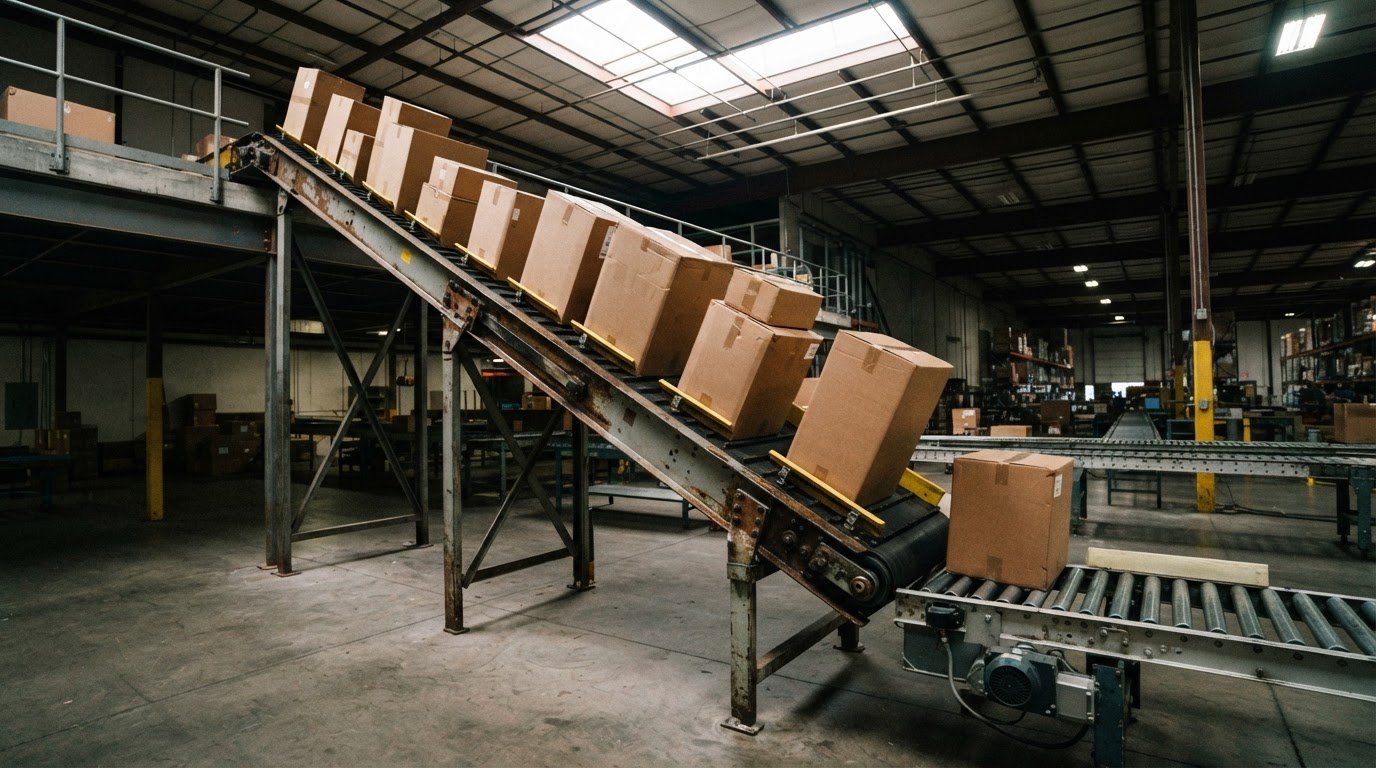
Gravity moves products downhill, but the belt controls how they arrive. Decline conveyor systems carry items from a higher point to a lower one. Belt friction, speed, and, where needed, cleats help limit sliding and manage spacing. A bottom transition can then transfer products to a horizontal line.
That distinction matters: a downward route is not simply an incline conveyor running in reverse. Product shape, weight, packaging, and bottom surface all affect whether items stay aligned or accelerate toward discharge. The right configuration accounts for these factors, the elevation change, and the downstream equipment.
This article explains how decline conveyors work, which design choices support stable product flow, and how to assess an application between levels. It also covers how speed control, transfer geometry, and connections to adjacent systems affect a practical layout, helping you identify the considerations for an integrated material handling solution.
Key Takeaways
- Match belt surface and cleat design to the product’s base, stability, and travel angle to help control movement downhill.
- Plan the elevation change, available horizontal run, and transfer points together so products move smoothly between levels.
- Account for the different forces on uphill and downhill routes when selecting conveyor components and configuring the system.
- Coordinate belt speed with product spacing and downstream equipment to help manage discharge flow and reduce congestion.
How does a decline conveyor work?
A decline conveyor uses a moving belt to carry products from a higher elevation to a lower one. Gravity helps move each item, while belt friction, speed, and product spacing influence its descent. If friction cannot hold a product reliably, it may slide backward, stall, or collide with the item behind it.
Belt selection starts with the product’s base and the route’s angles. A smooth-bottom carton may slide or skew on a steep decline, while a high-friction surface can improve its stability. Cleats can help retain products or control their spacing; ACSI recommends evaluating cleated belts for incline conveyor applications with slopes over 15°. The application and travel direction still determine the suitable configuration.
For a decline route, the elevation change and available horizontal distance establish its angle, length, and transition geometry. Applications can include grades up to 30 degrees, and cleats allow steeper grades. A bottom nose-over transition can guide products onto a horizontal conveyor. Smooth transitions at transfer points reduce shock, while vertical bend radius and angles should suit the product and connected equipment rather than create an abrupt change in direction.
Unlike an elevator, which lifts products mechanically, a decline conveyor uses gravity to lower them along a supported belt. A chute also relies on gravity but has no moving belt. The right choice depends on product control, route geometry, and how the line connects to other equipment.
In the United States, applicable safety requirements depend on the workplace, equipment design, and installation. Engineering should account for guarding, controls, access, and transfer points in relation to relevant workplace and machinery requirements.
Common hazards include products sliding, colliding, or bunching at discharge. Match belt friction and cleats to the product, control spacing, and design smooth transfer points to manage these risks.
Install the system by aligning supports, transitions, and connected equipment with the planned route. During maintenance, inspect the belt, guides, tension, bearings, and worn parts. If tracking or product flow changes, check alignment, belt condition, and discharge spacing.
Conveying products between different heights
A conveyor can connect an elevated production point with packing, shipping, or another process level. Layout decisions should account for the route, product behavior, and the equipment receiving items at each end.
Smooth Flow on Ascents and Descents
For smooth movement, coordinate the conveyor’s infeed and discharge elevations with nearby equipment. For example, a picked order can travel from a mezzanine to ground-level packing and shipping. Set transitions to avoid abrupt handoffs, and manage spacing so items don’t bunch at discharge. These details help maintain flow through the elevation change.
Product Size, Weight, and Stability
Assess each product’s size, weight, shape, center of gravity, packaging, and bottom condition. A smooth-bottom package may behave differently from an item with a textured base, especially as the belt changes direction. Test stability with actual products rather than assumptions.
Integration means coordinating the conveyor with adjacent equipment, not treating the sloped section as an isolated machine. Define the infeed and discharge points, required throughput, product spacing, and elevations of connected lines. A decline conveyor can lower orders from a mezzanine, while the next conveyor carries them to packing or shipping.
On steeper routes, cleats or flights can help prevent products from sliding backward on ascents. On descents, raised cleats spaced according to product length can meter items down at a controlled rate. Select their arrangement for the product and desired flow. Controlled spacing helps prevent pile-ups, collisions, and overruns.
For a coordinated layout, consider how material handling equipment connects the elevation change to the rest of the process.
Incline versus decline: what changes?
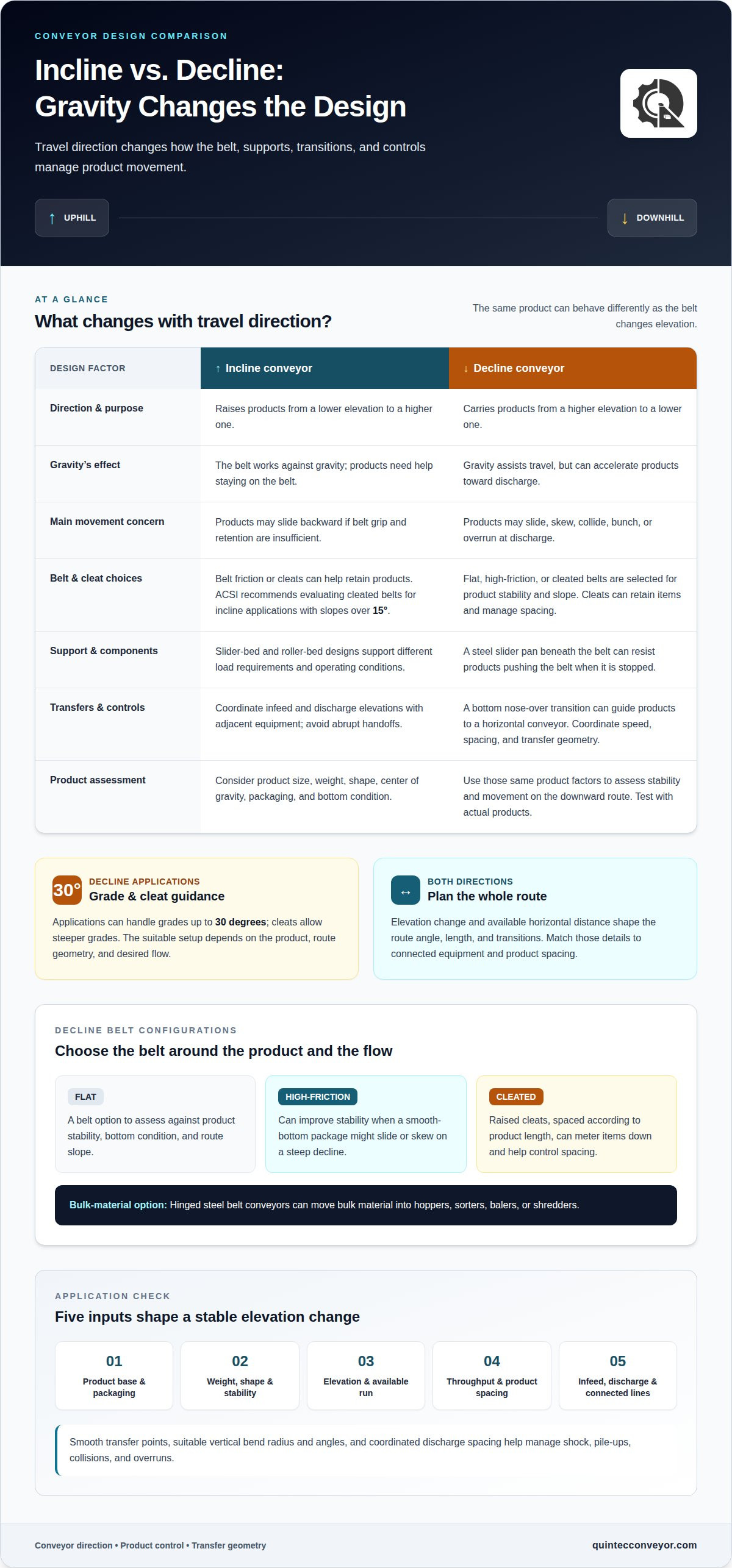
An incline conveyor raises products; a decline route lowers them. The direction affects how the belt, supports, transitions, and controls manage product movement.
Incline and Decline Design Differences
An incline conveyor works against gravity, so belt friction or cleats help retain products. On a decline, gravity assists travel, but product acceleration and belt movement need control. A steel slider pan beneath the belt can resist products pushing the belt when it is stopped. Design also depends on connected equipment, product characteristics, and route geometry.
Food and beverage, medical, automotive, e-commerce and retail, pharmaceutical, warehouse, and distribution operations use these systems. Layouts vary: a warehouse may route orders between levels, while a production line connects processing stages. Custom engineering aligns the conveyor’s direction, transitions, and supports with each facility’s flow.
Decline Conveyor System Types
Decline conveyor systems can use flat, high-friction, or cleated belts, selected according to product stability and slope. Cleats help retain items and manage spacing on steeper routes. For bulk materials, hinged steel belt conveyors move material into hoppers, sorters, balers, or shredders.
Incline models include slider-bed and roller-bed designs. These structures support different load requirements and operating conditions. Decline applications can handle grades up to 30 degrees, with cleats allowing steeper grades.
Decline Conveyor Cost Factors
The price depends on the project and is provided after a quote request. Key factors include elevation change, available conveyor length, product dimensions and weight, required throughput, and belt configuration. Cleats, transitions, supports, and connections to adjacent equipment also shape the system design.
Custom-built designs account for the facility layout and the process each conveyor serves. A route feeding a sorter may need different transfer arrangements from one serving a packing line. Define product details, operating direction, and equipment elevations to establish the design requirements and assess an integrated solution.
Conveyor speed and elevation changes
Elevation change and available horizontal distance establish a conveyor’s angle, length, and transition geometry. These dimensions shape how products enter, travel through, and leave a decline route. A longer run can create a gentler angle, while a tighter footprint may require a steeper descent and closer attention to speed control.
Gravity can accelerate products as they travel downhill. If belt speed and product spacing aren’t coordinated, items may collide, deform, or congest the discharge. Excessive speed can also cause hard landings, crushed cartons, or damaged seals and labels. Evaluate the product’s condition at both the upper infeed and lower discharge.
Set decline belt speed with the downstream conveyor in mind. Reduced speed, controlled braking, and synchronization with the receiving system help manage the handoff. Variable-speed drives can provide gradual acceleration, controlled deceleration, and speed matching between conveyors, supporting a more consistent transfer to the next process.
For comparison, incline conveyors move at a standard speed of 65 feet per minute. That figure doesn’t automatically suit a decline application: downhill travel adds gravity’s effect, and product stability varies with shape, packaging, and center of gravity. Consider the full route rather than selecting speed from the conveyor’s direction alone.
Map the elevation change, horizontal run, throughput, spacing, and adjacent equipment elevations before finalizing the layout. Then assess how a product behaves at the intended operating speed, especially near transfer points. A carton that travels smoothly on a straight belt may rotate or skew as the route descends, affecting alignment at discharge.
Use these steps to guide speed decisions:
- Coordinate discharge speed with the receiving conveyor.
- Account for product spacing and gravity-driven acceleration.
- Match transition geometry to the elevation and available length.
- Observe product condition and alignment through the handoff.
For a system designed around your elevation change and connected equipment, explore conveyor system options.
Keep speed control central throughout the decline. Products can accelerate, collide, deform, or congest the discharge if their speed is not controlled. Use these potential outcomes to assess the selected speed in relation to product movement along the route and at discharge.
Quintec Conveyors: Conveyors
Quintec Conveyors helps businesses plan conveyor systems that move products between levels and connect with surrounding processes. Turn to its conveyor integration, design, engineering, and installation services when an elevation change needs to fit an existing facility or a broader material handling plan.
For applications involving coordinated product movement, Quintec also offers Robotics & Automation, Infrastructure, and Additional Material Handling Equipment. The right system depends on the products, route, throughput, and adjacent equipment, so these requirements shape the engineering approach.
To discuss a conveyor project, contact Quintec Conveyors or visit quintecconveyor.com.
Plan the Next Step for Your Material Flow
Use the principles behind decline conveyor systems to shape a clear project brief. Describe the movement your operation needs, the products involved, facility constraints, and how the proposed route should connect with existing processes. A well-defined brief gives engineering discussions a practical starting point and helps keep equipment decisions aligned with operational priorities.
Quintec Conveyors offers Conveyors, Robotics & Automation, and Infrastructure for material handling projects. These capabilities can support projects where a level change is part of a broader facility or automation plan, rather than a standalone equipment decision. Bring together your process goals and layout considerations to explore a suitable approach.
Contact Quintec Conveyors to discuss your project and take a confident next step toward a more coordinated material flow.
Frequently Asked Questions
What is a decline conveyor system and how does it work?
A decline conveyor system uses a powered belt to move products from an upper infeed to a lower discharge. The drive moves the belt, while the conveyor structure supports the load along its route. In an automated line, coordinate the feed rate with the receiving equipment so products enter and leave without disrupting the surrounding process.
What industries and applications use decline conveyors?
Warehousing, distribution, and production operations use decline conveyors when products need to move between elevations. Applications include transferring picked orders to packing or directing materials toward sorting and processing equipment. The layout should reflect how products arrive, where they go next, and whether the receiving process can accept their flow without creating a queue.
How do you calculate the capacity and belt speed for a decline conveyor?
Start with the required product rate and the load each item places on the belt. Estimate belt speed by multiplying the target number of items per unit of time by the center-to-center spacing between items, using consistent units. Then assess the loaded conveyor at the intended rate. Product dimensions, spacing, and discharge behavior affect whether the planned throughput is practical.
What are the design requirements for conveyor belts on steep declines?
A steep decline needs a belt configuration suited to the specific product, rather than relying on slope alone. Consider the package’s base, shape, and orientation when selecting surface grip, cleat arrangement, and side guidance. Also assess transfers at the upper and lower ends. These design choices help limit product drift and keep the discharge aligned with the next process.