
7 Warning Signs Your Conveyor System Needs Maintenance

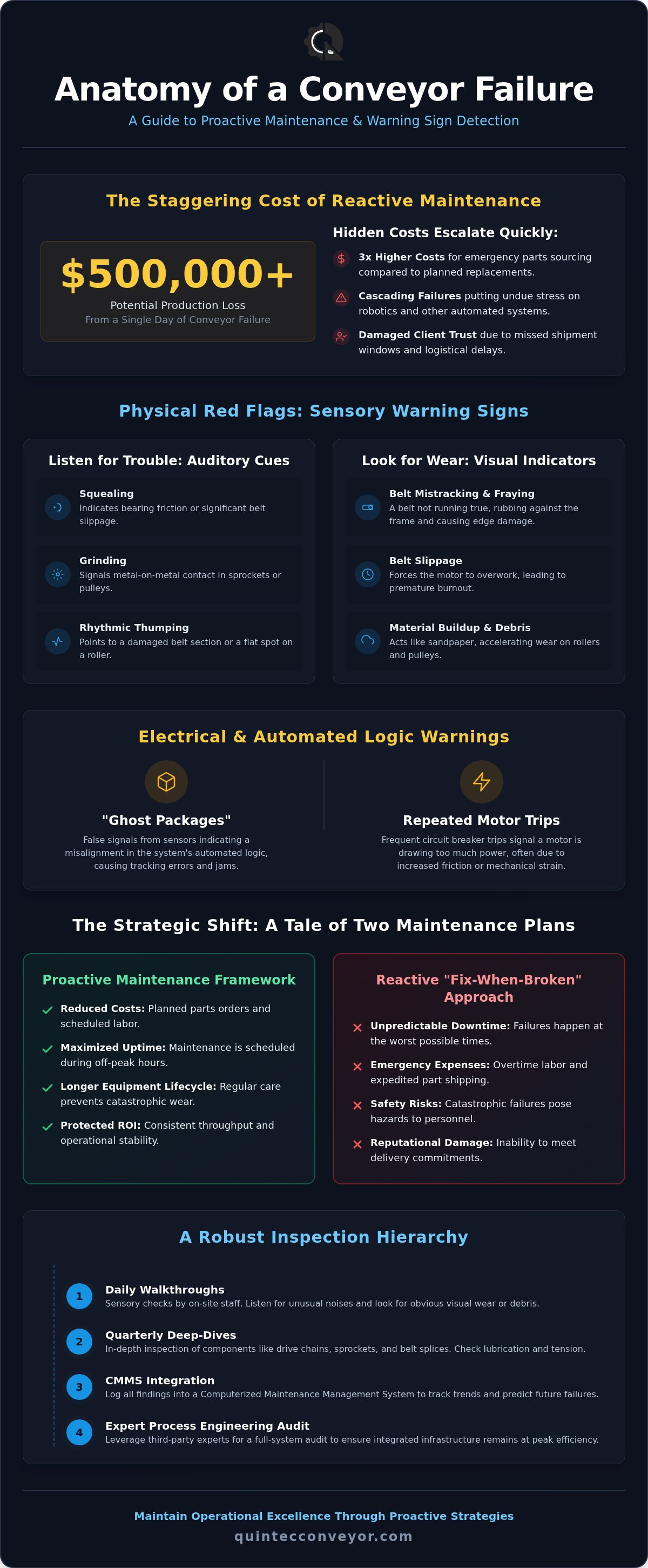
Did you know that a single day of conveyor failure in a high-volume facility can result in production losses exceeding $500,000? While a total system collapse feels like a sudden catastrophe, it's almost always the final stage of a long, visible decline. Learning to recognize the early Warning Signs of Impending Conveyor Maintenance is the difference between a controlled service interval and a logistical nightmare that halts your shipments. We know that your facility's throughput depends on the seamless integration of mechanical precision and automated logic. When one component falters, the entire process engineering chain is at risk.
This guide will help you identify the subtle mechanical, electrical, and logical signals that precede conveyor failure. By mastering these indicators, you'll protect your facility's ROI and significantly reduce the risk of emergency repair bills. We'll provide a clear checklist to train your staff on identifying wear, ensuring your equipment lifecycle is optimized for long-term stability. From unusual acoustic signatures to erratic sensor data, here is how you can stay ahead of the curve and maintain operational excellence through proactive maintenance strategies.
Key Takeaways
- Identify mechanical red flags like belt mistracking and rhythmic thumping before they escalate into catastrophic component failure.
- Understand how "ghost packages" and repeated motor trips serve as critical Warning Signs of Impending Conveyor Maintenance within your automated logic.
- Shift from reactive repairs to a strategic preventive maintenance framework to protect your facility’s throughput and long-term ROI.
- Establish a robust 2026 inspection hierarchy that balances daily walkthroughs with quarterly deep-dives and CMMS integration.
- Recognize when to leverage expert process engineering for a full-system audit to ensure your integrated infrastructure remains at peak efficiency.
The Strategic Impact of Impending Conveyor Maintenance
High-performance logistics systems exist on a sliding scale of efficiency. The shift from a stable operational state to impending failure is often quiet, marked by subtle mechanical or logical drifts that only a veteran eye catches. Identifying the Warning Signs of Impending Conveyor Maintenance is a core business strategy to protect facility throughput and long-term ROI. If you ignore these signals, the resulting erosion of efficiency compromises your output before a physical breakdown ever happens. Process engineering is vital in this context. By analyzing the flow of goods through an integrated conveyor system, engineers can identify systemic bottlenecks that stem from minor component wear. This holistic view ensures that maintenance isn't just about fixing a belt, but about optimizing the entire logistical chain to prevent a single failure from cascading through your facility.
The Hidden Costs of Reactive Maintenance
Reactive maintenance is a costly gamble that modern facilities can't afford to lose. While it's easy to focus on the immediate repair, the true "Cost of Downtime" includes lost labor hours, missed shipment windows, and damaged client trust. Industry data suggests that emergency parts sourcing can be up to three times more expensive than planned replacements. Recognizing the Warning Signs of Impending Conveyor Maintenance early prevents these spikes in expenditure. A sudden failure in a primary conveyor line often puts undue stress on secondary systems, including robotics and automation. This creates a chain reaction of hardware damage that extends far beyond the initial point of failure. Proactive planning keeps your budget stable and your shipping schedule intact. This foresight is equally important for non-mechanical infrastructure; for example, many facilities rely on Texas Septic Solutions for expert septic system oversight to prevent unexpected utility issues from halting production.
Maintenance as a Component of Industrial Infrastructure
Viewing conveyor health as a core pillar of your industrial infrastructure is essential for maintaining a stable environment. Excessive vibration from a poorly maintained drive motor doesn't just damage the conveyor; it can eventually impact the structural integrity of adjacent warehouse racking. By aligning your maintenance schedules with peak seasonal demand cycles, you ensure that your equipment is at peak reliability when your throughput requirements are highest. This proactive approach transforms maintenance from a burdensome expense into a strategic asset. It supports modern excellence and long-term operational stability, positioning your company as a reliable partner in a competitive market.
Physical Red Flags: Visual and Auditory Indicators of Wear
Physical symptoms are the most immediate Warning Signs of Impending Conveyor Maintenance. While digital monitoring provides vital data, your facility's daily walkthrough remains a cornerstone of operational health. Sensory feedback often reveals issues before they register on a control panel. Auditory cues are particularly telling. If you listen closely to your lines, you can categorize the sounds of decay:
- Squealing: Typically indicates bearing friction or significant belt slippage.
- Grinding: Signals metal-on-metal contact within sprockets or pulleys.
- Rhythmic Thumping: Points to a damaged belt section or a flat spot on a roller.
Visual inspections should focus on drive chains and sprockets. Misaligned components cause uneven wear patterns that are visible long before a total system halt. Additionally, material buildup and debris act like sandpaper on moving parts. Left unchecked, this grit accelerates the erosion of rollers and pulleys. Compliance with OSHA conveyor regulations requires keeping these systems clear and properly maintained to prevent safety hazards. If your team notices these physical red flags, it's time to consider a professional conveyor maintenance assessment to restore system integrity.
Conveyor Belt Wear Signs You Cannot Ignore
Belt mistracking is a primary culprit for edge fraying. When a belt doesn't run true, it rubs against the frame, creating heat and structural damage. Belt slippage is equally dangerous; it forces the motor to work harder, leading to premature thermal burnout. In modular systems, look for "scalloping" on the links. This uneven wear often indicates a pitch mismatch between the belt and the drive sprockets. High-tension environments must prioritize the inspection of belt splices. A separating splice is a ticking clock that leads to an unplanned shipment delay and potential safety risks.
Structural and Component Instability
Vibration is often the first sign of structural fatigue. In modular conveyor systems, excessive shaking can loosen fasteners and degrade support stands over time. Check for loose bolts and signs of frame swaying during peak load. Bearing failure is another critical concern. As bearings degrade, they generate significant heat and increase energy consumption. If a component feels hot to the touch or shows discoloration, it's already in a state of impending failure. These mechanical inefficiencies erode your ROI by driving up utility costs and shortening the equipment lifecycle.
Electrical and Automated Logic Warning Signs
While physical wear is often visible to the naked eye, digital and electrical signals provide a more precise diagnosis of internal system erosion. Modern facilities rely on a complex interplay of sensors and software to maintain high throughput. When this "nervous system" begins to falter, it generates specific Warning Signs of Impending Conveyor Maintenance that are easily missed if you only look for mechanical damage. Repeated motor trips are rarely just electrical glitches; they're a safety feature signaling that your hardware is under extreme duress. When a motor hits a thermal overload, it's usually fighting against mechanical resistance like a seized bearing or a misaligned belt.
Monitoring fluctuations in energy draw through your control system provides a clear window into this struggle. If a drive pulls higher amperage than its established baseline, it's a direct indicator of inefficiency. Programmable Logic Controller (PLC) error logs act as a digital diary of these events. These logs capture hardware degradation and communication faults long before the system enters a hard stop. Reviewing these logs allows your team to move from reactive troubleshooting to a proactive engineering mindset, identifying systemic weaknesses before they impact your shipping schedule.
Motor and Drive Performance Indicators
Excessive heat at the motor housing is a critical red flag that requires immediate attention. This heat often stems from poor ventilation, internal winding failure, or an overtaxed drive system. Inconsistent belt speeds or frequent Variable Frequency Drive (VFD) faults suggest that the electronic controls are struggling to maintain synchronization across the line. Don't overlook your physical senses as diagnostic tools. The smell of burning insulation or ozone is an immediate signal that electrical components are failing or that friction has reached a dangerous level. These olfactory cues often precede a total electrical failure, giving you a narrow window to intervene.
Automation and Sortation Errors
High-speed sortation conveyors rely on nanosecond precision to maintain facility-wide flow. When sensors misfire, you may encounter "ghost packages" where the system detects an item that isn't there, or fails to divert a real one. These misfires are common Warning Signs of Impending Conveyor Maintenance, often signaling hardware misalignment or lens contamination from debris. Timing issues in automated equipment are rarely simple software bugs. They're frequently caused by physical mechanical friction that slows down a diverter or pusher just enough to disrupt the PLC's logic. Identifying these logical "hang-ups" early ensures your automated systems continue to deliver the ROI you expect from a modern logistical infrastructure.
Establishing a 2026 Preventive Maintenance Framework
Transitioning from identifying symptoms to executing a solution requires a structured cadence. Noticing the Warning Signs of Impending Conveyor Maintenance is only the first step; your facility must have a protocol to act on them before they escalate. A modern framework prioritizes a clear hierarchy of inspection, moving from high-level daily observations to technical deep-dives. Implementing a Computerized Maintenance Management System (CMMS) allows you to digitize these records, ensuring every identified "Stage 1" warning is tracked through to resolution. This data-driven approach removes the guesswork from industrial planning.
Your floor staff are your most valuable diagnostic assets. Training them to recognize and report subtle shifts in sound or belt position enables early intervention. When a team member flags a minor drift, it prevents the cascading mechanical failure that often follows ignored symptoms. This collaborative approach is bolstered by the expertise of a conveyor system integrator. These experts understand how individual components interact within the larger ecosystem, providing a level of insight that goes beyond basic part replacement to ensure total system health.
The Daily Maintenance Walkthrough Checklist
A daily sweep ensures that small obstructions don't become major seizures. These checks take minutes but save hours of unplanned downtime. Focus on these critical areas during every shift change:
- Debris Check: Clear any material from the bed or return rollers to prevent abrasive wear.
- Belt Tracking: Verify the belt is running true to avoid the edge fraying discussed earlier.
- Safety Systems: Confirm all E-stops and pull cords are unobstructed and fully functional.
- Auditory Sweep: Listen for the squeals or rhythmic thumps that signal bearing or belt distress.
Weekly and Monthly Technical Audits
Technical audits focus on the internal health of the infrastructure. Weekly tasks should include checking lubrication levels for drive chains and inspecting bearings for excessive heat generation. On a monthly basis, your team must test tensioning systems and verify air pressure for pneumatic components to ensure precise diverter action. Reviewing system performance data for throughput degradation helps identify slow-moving failures that aren't yet audible. To ensure your facility remains at peak efficiency, you should schedule a professional conveyor maintenance audit to identify hidden vulnerabilities in your process engineering.
Partnering for Professional Maintenance and Engineering
Internal maintenance teams are vital for executing the daily and weekly protocols established in previous sections. However, there's a threshold where mechanical symptoms overlap with complex automated logic, requiring a deeper engineering perspective. Identifying the Warning Signs of Impending Conveyor Maintenance early is the first step, but professional intervention ensures those signs don't turn into permanent scars on your facility's throughput. When your team encounters chronic motor trips or persistent belt mistracking that defies standard adjustment, it's time to call for expert integration services. A full-system audit provides a holistic view of your operations, ensuring that one small adjustment doesn't create a bottleneck elsewhere in your process engineering chain.
Expert System Audits and Optimization
Quintec Conveyors brings over 100 years of collective industry experience to every audit, allowing us to diagnose complex issues that standard checklists might overlook. We look beyond the immediate repair to determine if a recurring wear point is actually a symptom of an inefficient flow. By utilizing professional warehouse design services, we can re-engineer sections of your line to eliminate stress points and extend the equipment's lifecycle. This proactive partnership ensures that your facility's health is managed with the same precision used in its initial design. It's about moving from a state of reactive patching to a strategy of modern excellence and long-term stability.
The Quintec Conveyors Approach to National Maintenance
Our national maintenance coverage ensures that your industrial material handling equipment receives consistent, high-level care regardless of location. As you scale your operations with advanced robotics and automation, the integration between hardware and software becomes more critical. Quintec Conveyors specializes in these integrated environments, helping you transition from legacy equipment to modern, low-maintenance solutions. We ensure that your warehouse racking, conveyors, and automated systems function as a single, cohesive unit. This steady, high-level competence instills a sense of security that your facility is prepared for peak seasonal demands and long-term growth. By partnering with a veteran guide, you gain a strategic ally dedicated to optimizing your equipment lifecycle and protecting your ROI through every Warning Signs of Impending Conveyor Maintenance cycle.
Securing Your Operational Future Through Proactive Integration
Maintaining a high-velocity facility requires more than just reacting to broken parts. It's about recognizing that every rhythmic thump, motor trip, or "ghost package" is a vital data point in your system's health. By establishing a rigorous 2026 preventive framework, you transform these Warning Signs of Impending Conveyor Maintenance into opportunities for optimization rather than sources of unplanned downtime. Protecting your ROI means looking beyond individual components to the entire process engineering chain that drives your facility's success.
When your internal teams reach the limits of standard troubleshooting, a strategic partner provides the necessary perspective to maintain peak efficiency. Quintec offers over 100 years of collective industry expertise and a national reach for comprehensive industrial material handling solutions. As specialists in complex warehouse automation and robotics, we ensure your infrastructure remains a stable foundation for your future growth. Partner with Quintec for professional conveyor maintenance and system integration. We're ready to help you turn operational challenges into long-term competitive advantages.
Frequently Asked Questions
What is the most common warning sign of conveyor failure?
Unusual noise is the most frequent indicator, specifically high-pitched squealing or metal-on-metal grinding. These sounds are critical Warning Signs of Impending Conveyor Maintenance that suggest bearing fatigue or significant belt slippage. While a system might remain operational during these early acoustic shifts, ignoring them guarantees a more expensive mechanical seizure. Catching these sounds early allows your team to schedule a targeted intervention during planned downtime rather than facing a sudden production halt.
How often should a professional conveyor maintenance audit be performed?
At a minimum, you should schedule a professional audit annually. Facilities operating 24/7 or handling high volumes often require semi-annual inspections to maintain peak efficiency. These audits go beyond basic part replacement; they evaluate the entire process engineering chain to identify systemic drifts. Professional engineers examine how your infrastructure handles peak loads, ensuring that your warehouse racking and automated systems remain synchronized with your conveyor's mechanical performance.
Can a conveyor belt be repaired, or does it always need replacement?
Minor surface damage or small punctures can frequently be resolved through cold vulcanization or mechanical fasteners. However, if you observe widespread edge fraying or deep longitudinal tears, replacement is usually the most reliable option. Repairing a severely compromised belt is often a temporary fix that leads to unexpected shipment delays later. A professional evaluation determines if the belt's structural integrity can still support your facility's required throughput and tension levels.
What causes a conveyor motor to overheat repeatedly?
Repeated overheating is almost always caused by excessive mechanical resistance. This happens when the motor must overcome friction from seized bearings, misaligned pulleys, or significant debris buildup in the conveyor bed. When the motor operates under these conditions, it draws higher amperage, leading to thermal overload trips. These events are vital Warning Signs of Impending Conveyor Maintenance, signaling that your hardware is fighting against internal forces that will eventually lead to total failure.
How do I know if my conveyor belt is mistracking?
You can identify mistracking by observing the belt's position relative to the center of the rollers and pulleys. If the belt consistently drifts toward one side of the frame, it's mistracking. Visual cues include frayed belt edges, material spilling over the sides, or fresh wear marks on the conveyor's structural steel. Addressing this early is essential, as a mistracking belt causes uneven tension and accelerates wear on drive components and motors.
Are there specific warning signs for modular vs. belt conveyor systems?
Modular systems typically show wear through "scalloping" on the plastic links or an audible clicking sound when the belt engages the sprockets. In contrast, traditional belt conveyors are more prone to edge fraying, slippage, and splice separation. While both systems will vibrate and generate heat as bearings degrade, the modular design's segmented nature means damage often stays localized to specific links before spreading to the drive assembly or supporting infrastructure.
What role does lubrication play in preventing conveyor maintenance issues?
Lubrication is the primary defense against friction-related heat and component seizure. It's essential for drive chains, bearings, and take-up units where metal-on-metal contact is constant. Without a consistent lubrication schedule, these parts experience rapid thermal expansion, leading to catastrophic failure. You must be careful to avoid over-lubrication, as excess grease can attract dust and grit. This creates an abrasive paste that actually speeds up the erosion of your precision-engineered components.
How can I reduce the cost of conveyor maintenance in my facility?
The most effective way to lower expenses is by transitioning from reactive repairs to a structured preventive maintenance framework. By catching minor issues during daily walkthroughs, you avoid the 3x cost multiplier associated with emergency parts and unplanned labor. Using a CMMS to track your equipment's history allows for better industrial planning. This data-driven approach ensures you replace parts based on actual wear rather than waiting for a failure that halts your shipments.